Unknown Material Identification by XRF
Unknown-material identification often starts with elemental composition. Rapid Analytical uses a Thermo Scientific ARL™ QUANT’X benchtop EDXRF system to help narrow the possibilities quickly.
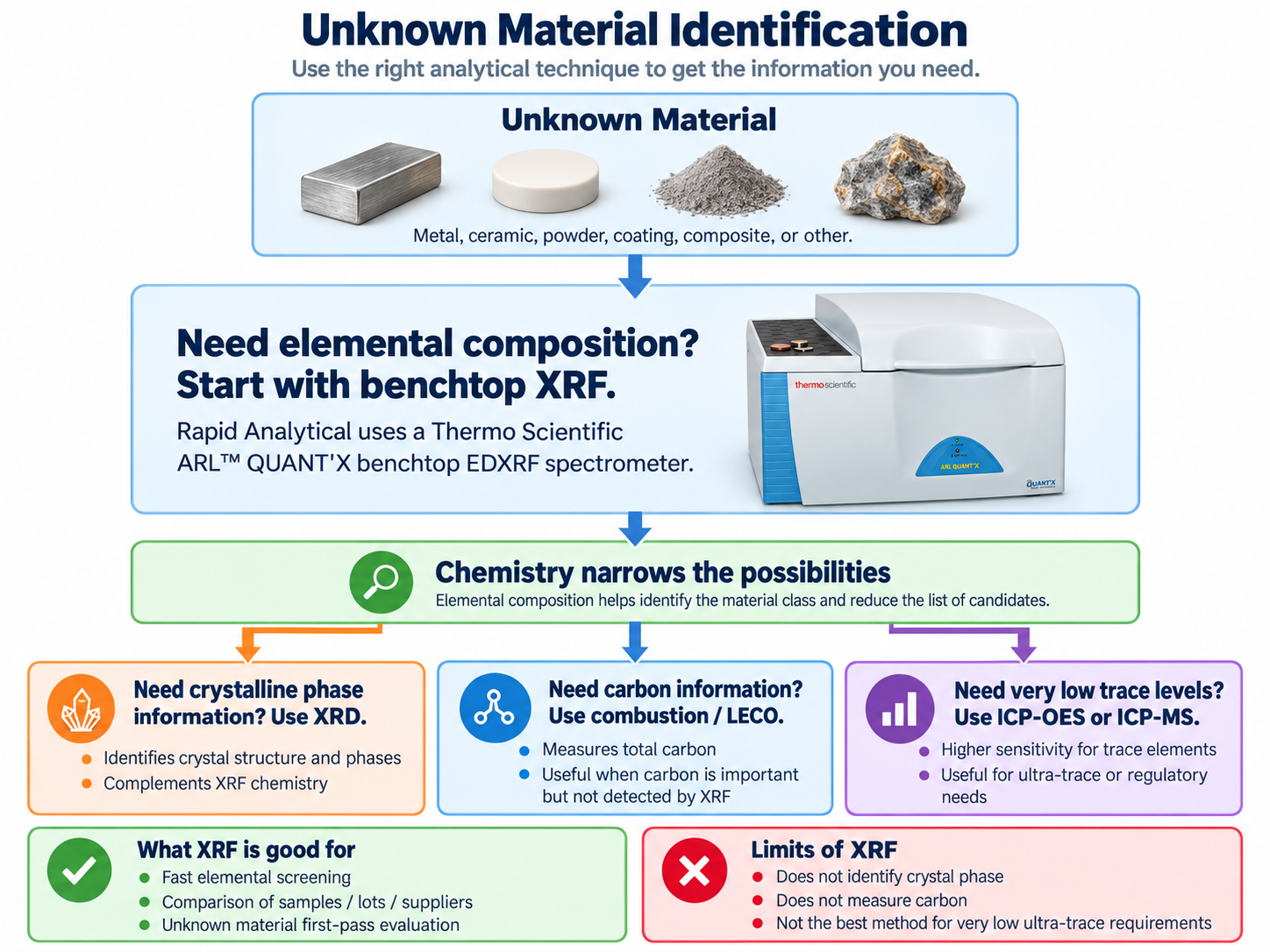
Open the full-size identification guide
What Can XRF Tell You About an Unknown?
XRF measures the elemental composition of the region exposed to the instrument. Depending on sample form and measurement conditions, it can help answer:
- Which measurable elements are present, and which appear to be major constituents?
- Does an unknown sample have chemistry consistent with a particular alloy or material family?
- Are two unidentified materials similar in elemental composition?
- Are notable metallic or inorganic impurities present at measurable levels?
Example: Substantial iron, chromium and nickel may suggest a stainless-steel alloy family. However, a screening composition alone does not verify the exact commercial alloy grade or all specification requirements.
Which Unknown Materials Can Be Screened?
Unknown metal or alloy
What XRF can help withElemental profile and possible alloy family.
Key limitationSurface contamination, plating and exact grade requirements.
Mineral or ceramic powder
What XRF can help withMajor measurable elemental constituents.
Key limitationCrystal phase cannot be determined from chemistry alone.
Ash or inorganic residue
What XRF can help withMeasurable inorganic elemental constituents.
Key limitationDoes not determine total carbon or organic fraction.
Process powder or recycled material
What XRF can help withScreening and comparisons across related samples.
Key limitationRepresentative sampling and heterogeneity affect interpretation.
Plated, coated or corroded object
What XRF can help withElements contributing to the analyzed surface region.
Key limitationSurface and substrate contributions may overlap.
Unusual materials require suitability and sample-acceptance review before shipping.
What XRF Cannot Identify by Itself
Exact compounds or crystalline phases: XRF measures elements, not crystal structure. For example, elemental chemistry alone cannot distinguish monoclinic, tetragonal and cubic zirconia. See XRF vs XRD when crystal phase matters.
Organic chemistry: The current benchtop EDXRF service does not identify specific polymers or organic compounds or measure total carbon, hydrogen or loss on ignition.
Exact commercial product grades: A composition can be consistent with a suspected alloy or material family without proving every grade, mechanical property or manufacturing requirement.
Layered objects and very low impurities: XRF information is affected by the depth and composition of the measured region. A low ppm requirement needs review of the actual detection and quantification limits for the target element and matrix.
How to Prepare an Unknown Sample
- Solid metals: When bulk composition is the goal, a clean, representative, relatively flat region is generally preferred.
- Powders and residues: Provide a representative portion in a clean, sealed, clearly labeled container.
- Coated or corroded samples: Do not remove the surface layer if that is the feature you want evaluated. Describe the objective before testing.
- Large or irregular pieces: Send dimensions and a photograph for suitability review before shipping.
See XRF Sample Submission for quantities and labeling. Do not ship hazardous, radioactive, reactive, or regulated materials without prior written acceptance.
What Will You Receive?
For an accepted sample, standard testing includes scientist-reviewed EDXRF measurement and a PDF report presenting applicable elemental results and method information. The report can help evaluate a likely material family, compare samples, or decide whether follow-up testing is needed. It is not a certified identification of every possible compound or material grade.
Should You Order or Request a Sample Review?
Standard elemental screening: $45 per accepted sample for suitable material. Request a review first: unusual geometry, hazardous material, a coating or layered structure, a specified ppm threshold, or a need for regulatory or certified results.
To help us assess suitability, provide the material description, what needs to be determined, approximate size or quantity, suspected elements (if any), and the number of samples. For elemental scope, see What Elements Can XRF Detect?.