Handheld XRF vs Benchtop XRF: Accuracy, Detection Limits & Applications
Handheld XRF or benchtop XRF—which gives the answer you actually need? Both measure characteristic X-rays emitted by elements in a specimen. A modern handheld analyzer can be excellent for rapid alloy identification and field screening. A benchtop energy-dispersive XRF (EDXRF) system is often better suited to controlled testing of submitted powders, minerals, ceramics, and batches. Neither is automatically more accurate for every element or sample. Calibration, preparation, matrix, measurement time, and the reporting requirement determine the result.
Quick answer: Choose handheld XRF when the object cannot leave the site or a rapid pass/fail decision is sufficient. Consider laboratory benchtop XRF when you can submit a representative sample, need controlled preparation or repeatable lot comparisons, or want a reviewed elemental report. If a legally defensible ultra-trace or accredited result is required, neither instrument alone necessarily meets that requirement.
What Rapid Analytical provides: mail-in benchtop EDXRF elemental testing with scientist-reviewed reports for suitable powders, metals, ceramics, minerals, and other inorganic samples. Rapid Analytical does not sell handheld XRF instruments or provide on-site handheld measurements.
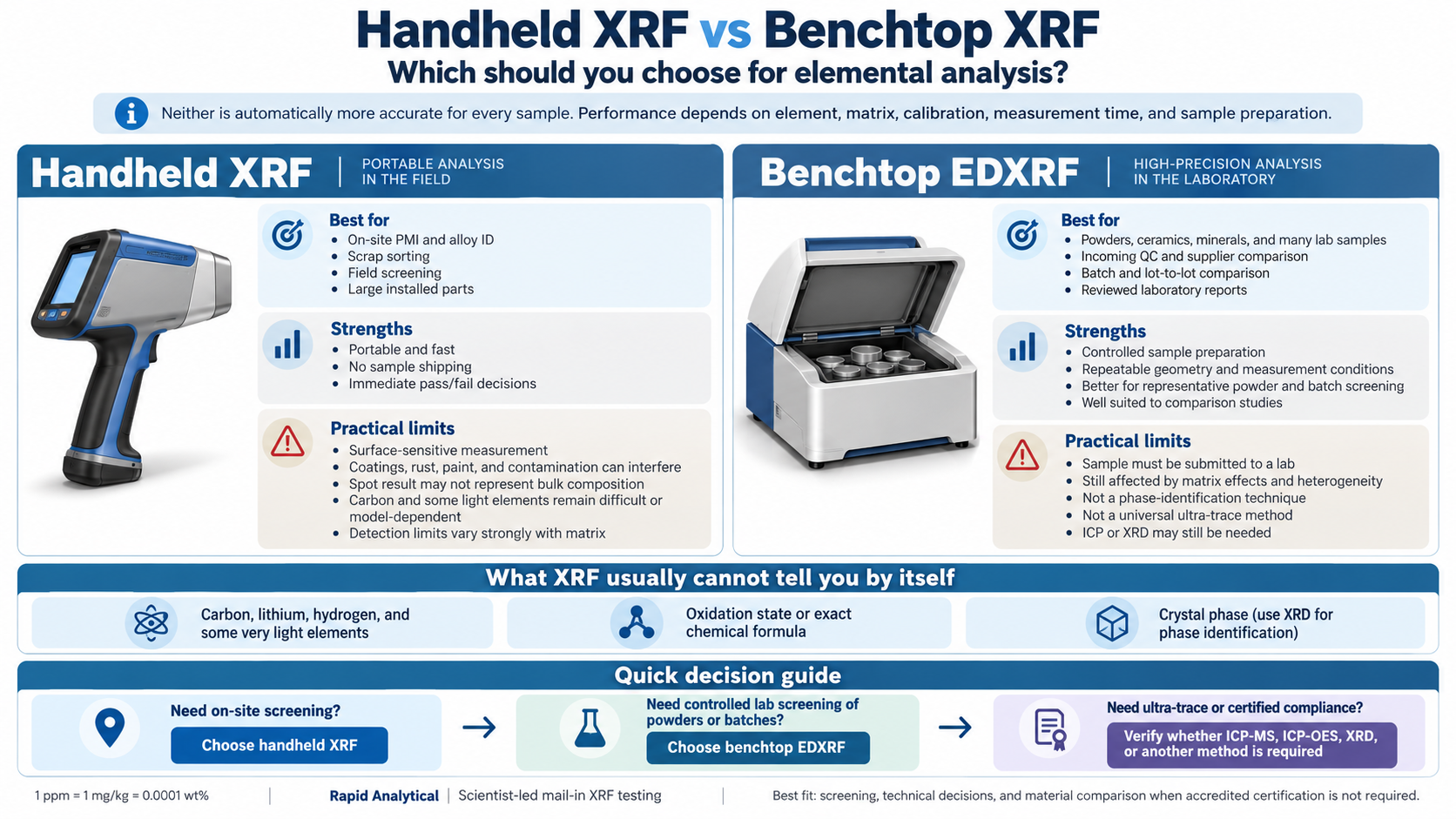
Handheld vs. benchtop XRF: at a glance
| Question | Handheld XRF | Benchtop EDXRF |
|---|---|---|
| Where is it used? | Shop floor, scrap yard, mine, jobsite, receiving dock. | Laboratory or controlled testing area. |
| What is its main advantage? | Immediate, nondestructive decisions without shipping a bulky object. | Controlled sample geometry, preparation, environment, and analytical workflow. |
| Typical samples | Alloys, pipes, castings, scrap, exposed mineral surfaces; powders in appropriate cups or stands. | Powders, pellets, metal pieces, ores, ceramics, residues, and other compatible samples. |
| Measurement time | Often seconds to a few minutes, depending on elements and required confidence. | Often minutes; can use multiple excitation conditions or repeat measurements. |
| Accuracy | Can be very good for suitable calibrated, homogeneous materials. | Can improve control and reproducibility, especially for properly prepared complex materials; not a universal accuracy guarantee. |
| Trace elements | Possible, but achievable detection limits vary widely with element, matrix, mode, and time. | Often offers more analytical flexibility; validated, sample-specific detection limits are still required. |
| Light elements (Na–S) | Basic handheld models may not report Mg, Al, Si, P, or S. Premium models can analyze Mg–S; selected units advertise Na detection, but sodium is especially challenging. Limits are matrix- and model-dependent. | Controlled geometry and, where equipped, vacuum or helium can help detect low-energy X-rays. Actual Na–S capability still depends on the installed instrument and validated method. |
| Primary limitation | Surface/spot representativeness, field conditions, sample shape and preparation. | Requires sample submission and may still suffer from matrix effects, heterogeneity, or insufficient sensitivity. |
Technical distinction: This guide compares handheld EDXRF and benchtop EDXRF, not wavelength-dispersive XRF (WDXRF). WDXRF has different spectral-resolution and sensitivity characteristics. More tube power by itself does not guarantee lower detection limits.
Can handheld XRF measure Na, Mg, Al, Si, P, and S?
It depends on the instrument—not simply whether it is handheld. Basic portable alloy analyzers may focus on heavier elements and omit some lighter elements. For example, Evident distinguishes its basic Vanta Element from the Vanta Element-S, which is designed to measure Mg, Al, Si, P, and S. Other advanced handheld systems can also measure these elements under suitable conditions.
- Na (sodium): Particularly challenging because its characteristic X-ray energy is approximately 1.04 keV. Air gaps, detector or instrument windows, surface conditions, and the matrix strongly attenuate the signal. Selected systems, such as Bruker TITAN, advertise Na-to-U detection; that does not establish reliable sodium quantification at trace levels in an arbitrary sample.
- Mg and Al: Measurable by many modern light-element-capable handheld systems, especially in suitable alloy applications; performance can degrade for low concentrations, uneven surfaces, or unfavorable matrices.
- Si, P, and S: Available on appropriately configured portable analyzers. Element-specific detection limits still vary by alloy family, soil/mineral matrix, sample preparation, and measurement time. It would be incorrect to say that all handheld XRF systems cannot measure sulfur.
- Laboratory EDXRF: Stable sample placement, consistent powder preparation, and an appropriate measurement atmosphere can improve reproducibility and light-element performance. But the presence of vacuum capability does not guarantee that every element in the Na–S range can be quantified by Rapid Analytical’s routine method.
Customer takeaway: If Na, Mg, Al, Si, P, or S is critical to your decision, provide the sample material, target element, and required wt% or ppm threshold before ordering. We can assess whether the mail-in ARL QUANT’X EDXRF service is suitable or whether another method is required.
Examples of commercial handheld XRF systems (for comparison only)
The following instruments illustrate current portable capabilities. Rapid Analytical does not sell, rent, or provide handheld analyzers.
- Thermo Scientific Niton XL5 Plus — compact handheld XRF for alloy identification, scrap, mining, and environmental or product screening; manufacturer describes application-specific calibration and fundamental-parameters (FP) models.
- Evident Vanta Max — field geochemistry, soil screening, and metals applications, with optional accessories and calibrations for specific sample types.
- Hitachi X-MET8000 — handheld family with variant-dependent filter, calibration, and light-element capabilities; some versions advertise Mg-to-U analysis.
- Bruker TITAN — handheld unit with an SDD, adjustable excitation and filters; manufacturer specifies an Na-to-U elemental range for the cited configuration.
Important: An advertised element range means an element may be measurable under suitable conditions; it does not mean every element can be quantified at 1 ppm, in every material, at every measurement time. Model options and software calibrations also matter.
What are the real XRF detection limits in ppm?
There is no scientifically defensible universal “handheld = X ppm, benchtop = Y ppm” limit. The limit of detection (LOD) is specific to the element + sample matrix + instrument configuration + measurement procedure. For reference, 1 ppm = 1 mg/kg = 0.0001 wt% in a solid; 100 ppm = 0.01 wt%.
One useful published manufacturer example is the Thermo Scientific Niton XL5 Plus RoHS application note, Table 1. The reported illustrative handheld LODs below are in ppm (mg/kg), using a 3-sigma criterion and 60 seconds per filter (120 seconds total):
| Element | Polyethylene (PE) | Tin-base | Iron-base |
|---|---|---|---|
| Lead (Pb) | 1 ppm | 79 ppm | 63 ppm |
| Cadmium (Cd) | 4 ppm | 140 ppm | 13 ppm |
| Chromium (Cr) | 4 ppm | 48 ppm | 66 ppm |
Interpretation: Even on the same handheld analyzer, a published Pb detection limit ranges from 1 to 79 ppm across these matrices. The difference is not a universal handheld-vs-benchtop effect; it shows why matrix matters. These are manufacturer-reported application conditions, not performance claims for Rapid Analytical, not routine guarantees, and not a head-to-head comparison against our benchtop system.
For another context, US EPA Method 6200 lists historical interference-free field-XRF example LODs in clean quartz sand of approximately 20 ppm Pb, 100 ppm Cd, and 150 ppm Cr, with long 100–600-second measurements. The EPA explicitly warns that such figures are guidance only and change with instrument, matrix, and operating conditions. They should not be substituted for instrument- and sample-specific validation.
How to judge a “10 ppm” claim: Ask for the element, sample matrix, acquisition time, whether the quoted figure is an instrument LOD or a validated method LOD, and the criterion for quantification (LOQ). A concentration just above LOD may be detected without being accurately quantified. Increasing counting time can reduce counting noise approximately with 1/√time in a counting-statistics-limited case, but it does not eliminate systematic bias, spectral overlap, or poor sample preparation.
For the distinction between detected, quantified, and not detected, see XRF Detection Limits: ppm, wt%, and What “Detected” Means.
How accurate are handheld and benchtop XRF results?
Accuracy means closeness to a known or accepted reference value. Precision means repeatability between measurements; a result can be repeatable yet systematically wrong. Relative error can be written as 100 × (measured − reference) / reference. For example, 4.7 wt% reported against a 5.0 wt% certified value is a −6% relative bias, or −0.3 percentage points. This is an explanatory calculation, not a test result from either instrument.
Neither portability nor laboratory location is a substitute for demonstrating performance with a matrix-matched certified reference material, appropriate method calibration, measurement replicates, and suitable sample preparation. FP/“standardless” software can correct modeled absorption and enhancement effects, but it does not make matrix mismatch or interference disappear.
What published research actually found
A 2014 peer-reviewed study in Journal of Analytical Atomic Spectrometry compared benchtop and handheld EDXRF on prepared plant-material pellets. Both approaches achieved useful results: reported LODs were approximately 20 mg/kg for Fe and Mn and 100 mg/kg for P, K, Ca, S, and Si under that study’s conditions. This is evidence that a suitable handheld system can perform comparably—not proof that every handheld, element, or matrix will.
In a separate 2020 study in Soil Science Society of America Journal, prepared pressed-powder pellets generally correlated better with benchtop XRF than direct field-moist measurements. Moist field measurements often underestimated concentrations, and calibration improved agreement. This demonstrates that how a powder is prepared can matter as much as which instrument holds the detector.
A 2022 tutorial review in Journal of Analytical Atomic Spectrometry emphasizes sampling depth, results near LOD, and uncertainty interpretation as essential to responsible handheld-XRF use. The same physical principles remain relevant to benchtop EDXRF.
What handheld XRF can do well—and where it struggles
Strong applications
- Positive material identification (PMI): sort common metal alloys and identify many grades at the receiving dock or jobsite, provided the alloy calibration and discriminating elements are measurable.
- Scrap sorting and recycling: quickly separate many Cu-, Ni-, stainless-steel-, and high-alloy families on accessible, suitably cleaned surfaces.
- Mining and environmental field screening: identify areas or specimens for follow-up sampling and confirmatory analysis.
- Large or installed objects: analyze a pipe, vessel, casting, or part that cannot practically be shipped to a laboratory.
Limitations customers frequently overlook
- Not necessarily bulk composition: XRF measures an energy- and matrix-dependent near-surface volume. Rust, paint, plating, contamination, or segregation can dominate what a handheld probe sees.
- Not every alloy grade can be distinguished: low-carbon versus higher-carbon stainless steels, for example, usually require a method capable of measuring carbon; conventional handheld XRF does not directly verify a low-carbon “L” grade.
- Powder problems: moisture, coarse particles, low packing density, segregation, uneven cups, and insufficient measurement area can produce misleading concentrations.
- Interference and matrix effects: overlapping elemental peaks, absorption, and enhancement can bias a software-generated number. An instrument’s reported uncertainty often reflects counting statistics, not all sources of uncertainty.
- Light-element limits: Na is especially difficult in routine handheld use, while many modern premium systems can measure Mg, Al, Si, P, and S with suitable configurations. A premium handheld can outperform an older or poorly configured benchtop system for some elements; compare actual method validation rather than instrument category alone.
When is laboratory benchtop XRF a better choice?
A laboratory approach is attractive when samples can be collected, labeled, mixed, dried or otherwise prepared as appropriate, measured with consistent geometry, and compared across lots. Rapid Analytical uses Thermo Scientific ARL QUANT’X benchtop EDXRF for mail-in elemental screening. The ARL QUANT’X family is designed for multiple sample forms and configurable excitation and measurement conditions. Actual performance depends on the installed detector, atmosphere, calibration, and method; specifications for newer QUANT’X configurations should not automatically be assumed for every installed unit.
In practical terms, the advantages come from controlled analysis, not merely putting the instrument on a bench: reproducible sample placement, appropriate measurement conditions, choice of preparation, verification, and an analytical report.
- Incoming powder QC: compare two zirconia, alumina, carbide, mineral, or industrial-powder lots for major and detectable minor elemental differences.
- Material identification: screen an unknown inorganic powder, metallic fragment, or mineral concentrate for its elemental fingerprint.
- Process troubleshooting: look for unexpected detectable metal contamination or composition shifts across samples.
- Multi-sample comparisons: evaluate whether measured elemental differences exceed expected measurement and sampling variability.
Read more about powder analysis, metal analysis, and powder sample preparation.
What neither XRF system can reliably tell you
- Carbon, hydrogen, nitrogen, oxygen, lithium, and boron: routine XRF is not a universal solution. Specialty windows may enable some light-element signals on certain configurations, but that is not equivalent to a validated total-carbon, oxygen, lithium, or boron assay. Use combustion analysis, inert-gas fusion, ICP after suitable preparation, or other appropriate methods when required.
- Oxidation state or compound identity: elemental Cr cannot establish hexavalent chromium (Cr VI); total Fe cannot establish FeO versus Fe₂O₃; elemental Si cannot identify quartz versus an amorphous silica phase.
- Crystal phases: XRF does not replace XRD for distinguishing phases or crystal structures. See XRF vs XRD.
- Extremely low concentrations in every matrix: single-digit-ppm or sub-ppm targets sometimes require validated ICP-OES/ICP-MS or another method. See XRF vs ICP-OES / ICP-MS.
- Certified regulatory compliance: ordinary screening results are not automatically accredited test reports or evidence of compliance with a specified regulation. The required method and reporting credentials must be checked first.
Also, percentages reported as oxides (such as SiO₂ or Al₂O₃) may be calculated from elemental measurements; a calculated oxide-equivalent is not proof that the sample contains that chemical phase.
Which method should you choose for your material?
| Your question | Most practical first step |
|---|---|
| Is this installed pipe or large part the expected alloy? | Handheld XRF PMI, with a calibration suitable for that alloy; use another method when carbon is decisive. |
| Are these two ceramic or metal powder lots elementally different? | Submit representative samples for controlled laboratory EDXRF screening and compare results. |
| Which soil locations may be contaminated? | Handheld XRF for field screening; validate critical results with the appropriate laboratory method. |
| Is my sample below a strict 5 ppm impurity specification? | First confirm a validated LOD/LOQ for that element and matrix; ICP-MS or another technique may be needed. |
| Does a coating contain chromium, or is it specifically Cr(VI)? | XRF may screen total Cr; oxidation-state testing requires a different validated technique. |
| Is my zirconia sample monoclinic or tetragonal? | XRD, not XRF. |
| I have an unknown powder and want an affordable initial elemental screen. | Mail-in benchtop EDXRF may be a suitable starting point, after sample-suitability review. |
Frequently asked questions
Is benchtop XRF always more accurate than handheld XRF?
No. Under matched sample preparation and a suitable calibration, handheld instruments can produce comparable data for some elements. Laboratory EDXRF is valuable for control, flexibility, repeatability, and the ability to prepare representative samples; accuracy must still be established for the actual material.
Can handheld XRF measure 1 ppm?
Sometimes, for a particular element and favorable matrix under a specified counting time. That does not mean 1 ppm accuracy, 1 ppm quantification, or 1 ppm capability for every material. The manufacturer Pb-in-polyethylene example above illustrates this distinction.
Will XRF tell me the exact chemical formula of an unknown powder?
Not by itself. XRF measures elemental signatures and can support composition screening. Distinguishing oxides, minerals, compounds, and crystal phases can require XRD or complementary methods.
Does a higher X-ray tube power guarantee a better result?
No. Detector efficiency, spectral background, filters, measurement geometry, counting time, calibration, sample condition, and interferences can dominate analytical performance.
Need elemental testing, not another instrument?
Rapid Analytical offers mail-in benchtop EDXRF screening starting at $45 per standard sample. The service is suited to powders, metals, minerals, ceramics, and many other compatible inorganic materials. Standard work includes a reviewed PDF elemental report by email; results are normally available within 2 business days after sample receipt and acceptance.
Before ordering, describe (1) your material, (2) the element or question of interest, and (3) the decision threshold—for example, 0.1 wt% Ni or 10 ppm Pb. We can assess whether routine XRF screening is a sensible first test or whether a different method is more appropriate. This service is intended for screening and technical decisions when accredited certification is not required; no universal ppm detection limit is promised.
Before shipping, review the sample submission guidance. For a specific ppm threshold or accreditation requirement, request a method-fit review first.