XRF Analysis of Ceramics and Oxide Powders
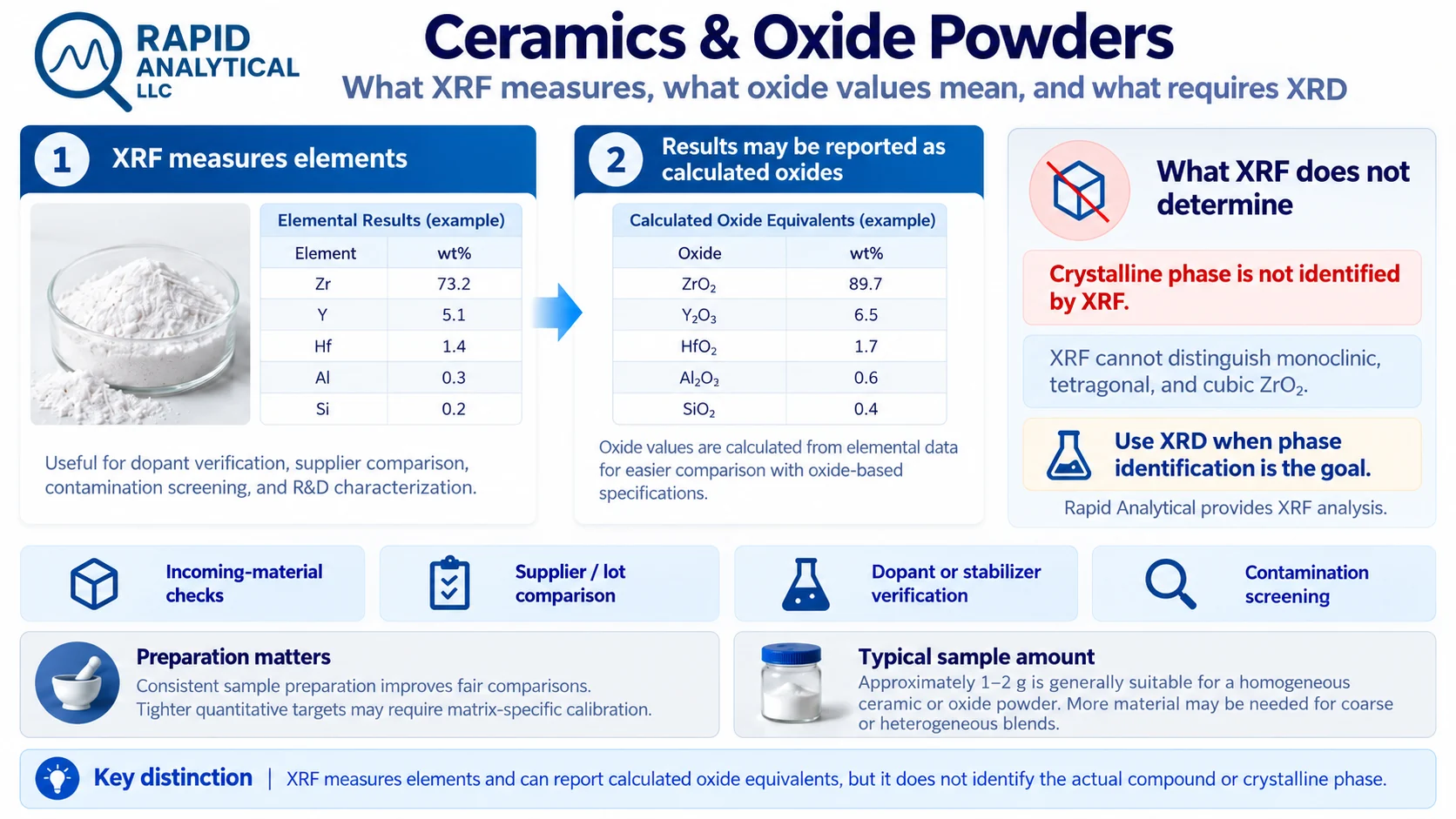
EDXRF is a strong fit for many ceramic raw materials and oxide powders because it can rapidly measure multiple inorganic elements without requiring acid digestion. Typical applications include incoming-material checks, supplier comparison, dopant verification, contamination screening, and R&D characterization.
Typical Materials
Zirconia-based powders, alumina, silica-rich materials, chromia, titania, refractories, ceramic blends, pigments, catalyst materials, mineral-derived powders, and other inorganic oxide systems.
Commercial Raw-Material & Refractory Use Cases
- Incoming raw-material verification: compare oxide/mineral feedstocks against prior lots or supplier data.
- Alternate supplier qualification: screen candidate powders, aggregates, or imported materials for elemental differences.
- Off-spec batch investigation: compare suspect production material with known-good lots or target formulations.
- Refractory recycling: screen reclaimed or recycled refractory material for major chemistry and contamination differences.
- Custom formulation work: compare development batches, additives, dopants, or raw-material substitutions.
What XRF Results Mean — and What They Do Not
XRF measures elemental composition. Results may also be reported as calculated oxide equivalents, but those oxide values are calculated from the elemental data and do not identify the actual compound or crystalline phase. For example, XRF cannot distinguish rutile from anatase TiO₂, calcite from aragonite CaCO₃, or quartz from other SiO₂ structures. Phase identification requires XRD; Rapid Analytical currently provides XRF analysis.
Preparation and Quantitative Fit
Consistent sample preparation supports fair comparisons, while tighter quantitative targets may require matrix-specific calibration. See the powder preparation guide, XRF accuracy guide, and Fundamental Parameters guide for details.
Sample Amount
Approximately 1–2 g is generally suitable for a homogeneous ceramic or oxide powder. More material may be requested for heterogeneous blends or coarse raw materials. Samples should be cleanly packaged and clearly labeled.
Related Ceramic & Oxide Guidance
For powder preparation, see XRF Sample Preparation for Powders. For phase-identification limits, accuracy, and other XRF method questions, see the XRF Testing FAQ. Current service pricing is summarized on XRF Testing Cost.