What Elements Can XRF Detect?
XRF can identify many elements in metals, minerals, powders, catalysts, and ceramics. Rapid Analytical uses a Thermo Scientific ARL™ QUANT’X benchtop energy-dispersive XRF (EDXRF) spectrometer with an SDD detector and vacuum capability. Thermo Fisher specifies a broad fluorine (F) through uranium (U) elemental range for the appropriate QUANT’X configuration.
Whether an element is detected in your sample depends on what is actually present, its concentration, the sample matrix, and the measurement conditions. An element missing from a report does not mean the instrument is incapable of measuring it. The practical goal is to select an analysis that answers your materials question.
Which Elements Can Be Analyzed?
Use this color-coded periodic table to see common XRF targets, elements requiring special conditions, and elements outside our current measurement scope.
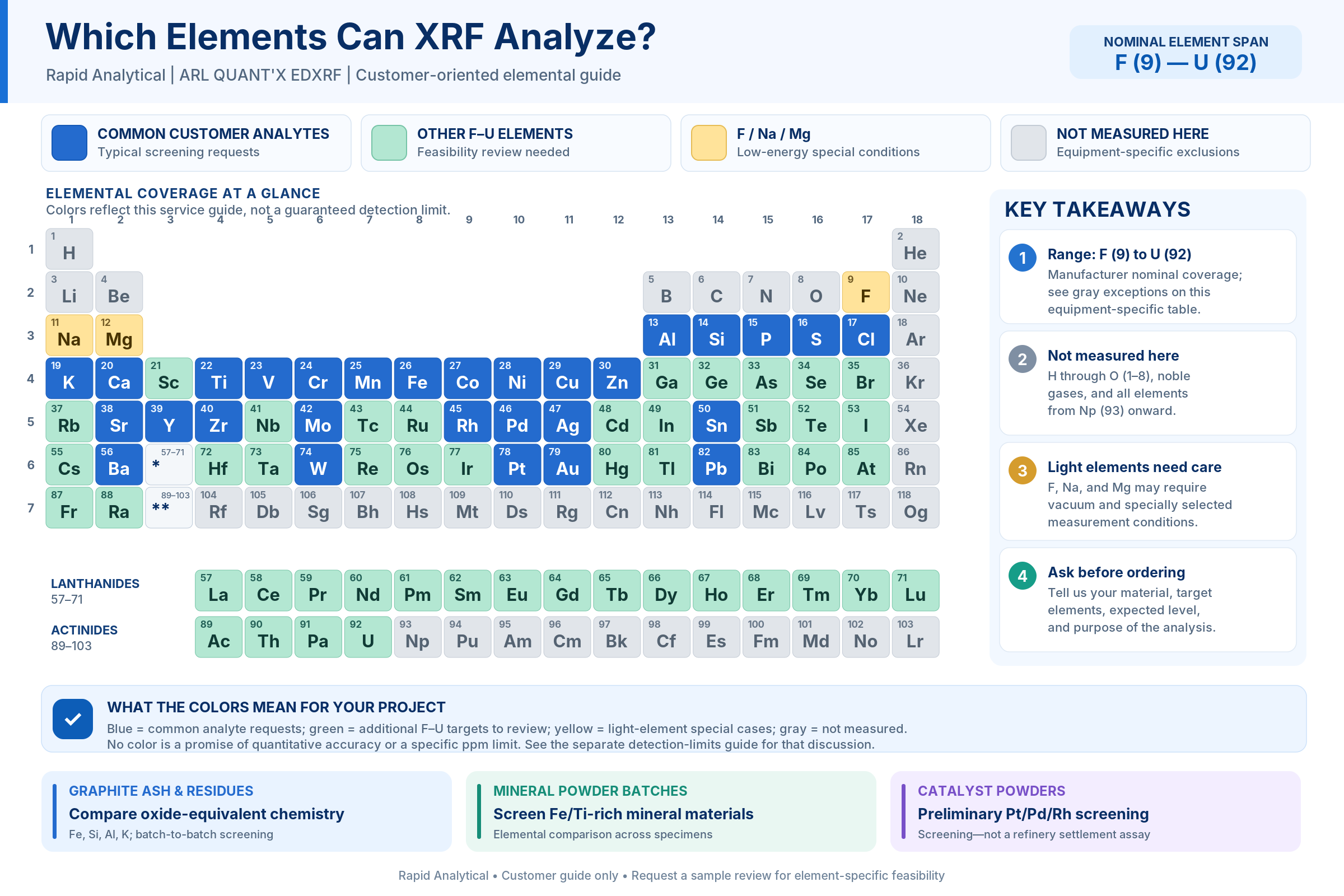
View full-size periodic table (zoom to read on mobile)
Need a specific detection limit? Read XRF Detection Limits: ppm, wt%, and What “Detected” Means or request a sample review with your material type, target elements, and expected concentration.
What Happens When You Send a Sample?
EDXRF measures characteristic X-ray signals from the elements present in the portion of material analyzed. Depending on the sample and method, the report can help identify major constituents, estimate elemental percentages, compare related samples, or screen for selected metals and impurities.
- Unknown metal: determine whether its measured chemistry is consistent with an alloy or metal-bearing material.
- Powder or mineral: identify major measurable elements and compare chemistry among samples.
- Catalyst or recovery material: screen for Pt, Pd, Rh and other elements of interest.
- Graphite or carbon-rich material: screen for measurable inorganic impurities, rather than measure carbon purity.
These applications reflect the types of material and analyte questions received by Rapid Analytical. See Metal Analysis, Powder Analysis, and Catalyst & Metal Recovery Screening.
Can XRF Measure Fluorine, Sodium, and Magnesium?
Yes, these elements fall within the manufacturer’s specified F–U QUANT’X range. Their low-energy fluorescent X-rays can be absorbed by air, surface layers, the specimen, and the detector window. Vacuum helps reduce air-path absorption; sample preparation and excitation conditions also matter. For fluorine, sodium, or magnesium, share the expected concentration and material type so the measurement approach can be assessed.
Which Elements Need a Different Test?
With Rapid Analytical’s current routine EDXRF service, elements lighter than fluorine—including lithium (Li), boron (B), carbon (C), nitrogen (N), and oxygen (O)—are not offered as direct quantitative analytes. For example, a graphite sample can be screened for certain inorganic impurities, but this XRF service cannot certify its carbon percentage.
When an XRF report lists SiO₂, Al₂O₃, or Fe₂O₃, these are generally calculated oxide-equivalent values, not direct oxygen determinations or proof of a specific crystal phase. See XRF vs. XRD and XRF vs. ICP-OES / ICP-MS for guidance on other methods.
Check Your Sample Before Ordering
Include three details in your request: (1) material type, (2) elements of interest, and (3) expected concentration or required detection limit. These details help determine whether the standard EDXRF screening service is a good fit or whether a different analytical approach would better answer your question.
For details on measurement uncertainty and preparation, see How Accurate Is XRF Analysis? and XRF Sample Preparation for Powders.
Technical Reference
Thermo Fisher Scientific, ARL QUANT’X EDXRF Spectrometer Brochure. Detector configurations and element-dependent sensitivity. The manufacturer’s platform-range specification does not guarantee a fixed detection limit for every sample.