
How Accurate Is XRF Analysis?
XRF can provide useful qualitative and quantitative elemental information, but accuracy is not a single fixed number. It depends on the element, concentration, sample matrix, preparation, calibration approach, geometry, and how representative the measured region is.
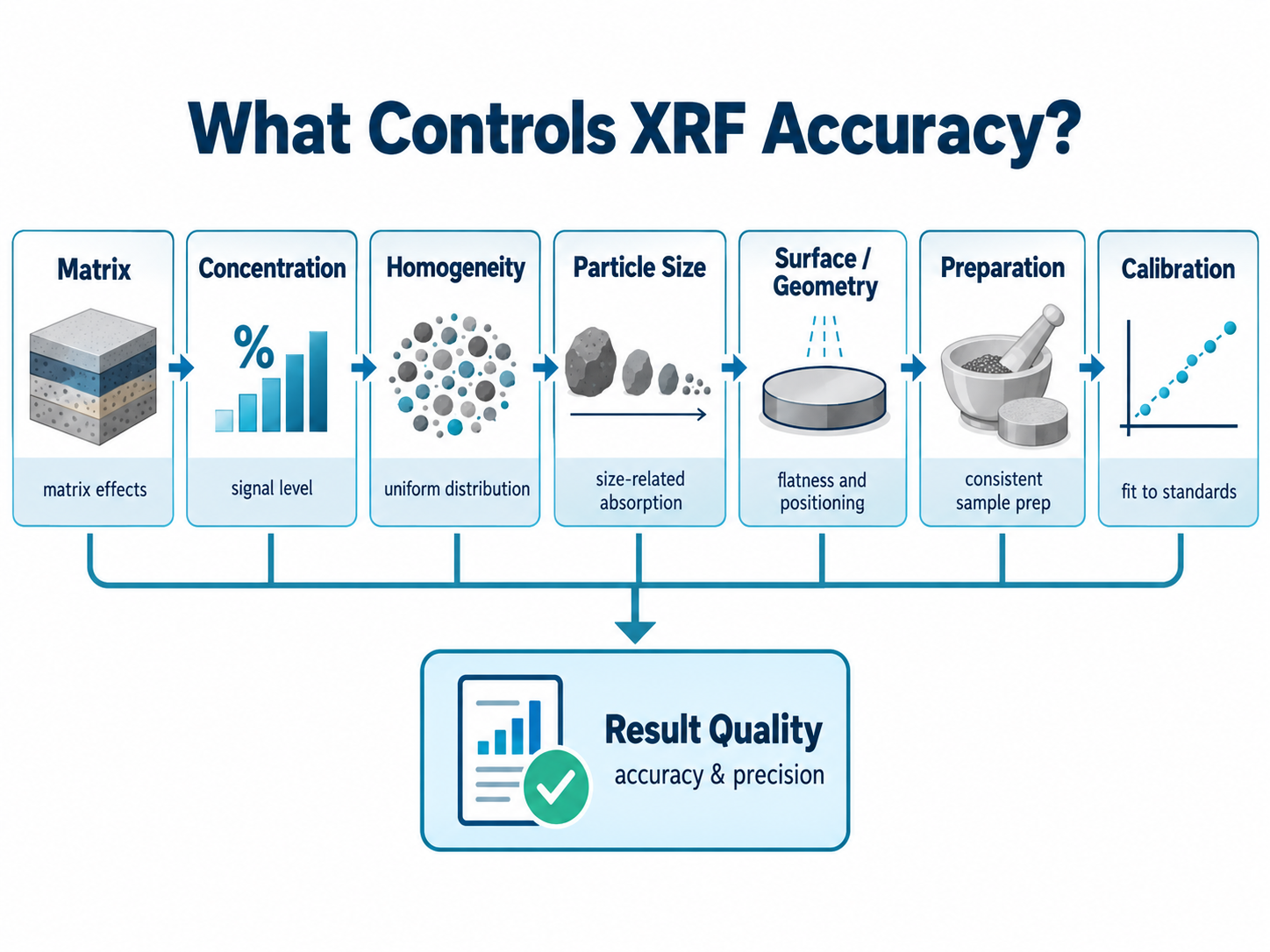
What Accuracy Means in Practice
The factors shown above interact. A homogeneous, well-prepared sample measured with an appropriate method and calibration can provide stronger quantitative agreement than a heterogeneous, coarse, irregular, or poorly characterized sample. For that reason, uncertainty should be considered for the actual sample and method rather than assumed from a generic percentage.
Rapid Analytical reports measurement uncertainty or error information where applicable and identifies important method limitations when a sample is not a good fit for routine XRF.
Screening vs. Higher-Accuracy Quantitative Work
Standardless or Fundamental Parameters methods are useful for screening, supplier comparison, lot-to-lot checks, unknown-material evaluation, and R&D. When tighter quantitative agreement is required, matrix-specific calibration and appropriate reference materials may be needed. See Standardless XRF / Fundamental Parameters.
Preparation matters: For powders, see XRF Sample Preparation for Powders. For solid metal surface and geometry considerations, see XRF Metal Analysis. Additional method questions are covered in the XRF Testing FAQ.
Technical references: IAEA — Fundamentals of XRF Analysis ↗
Need help deciding whether XRF fits your sample?
Send the material type, approximate sample count, and what needs to be learned. Rapid Analytical can review method fit before anything is shipped.