XRF Powder Analysis
Mail-in benchtop EDXRF analysis for powders, minerals, ceramics, ash, silica, catalyst residues, and other inorganic materials. XRF is useful for elemental screening, supplier comparison, lot-to-lot checks, and R&D.
Powder Samples & Applications
General powder analysis supports incoming-material checks, supplier comparisons, troubleshooting, and research and development. For ceramic and oxide powders, see Ceramics & Oxides; for ores, minerals, and concentrates, see Ores & Minerals.
Sample Amounts
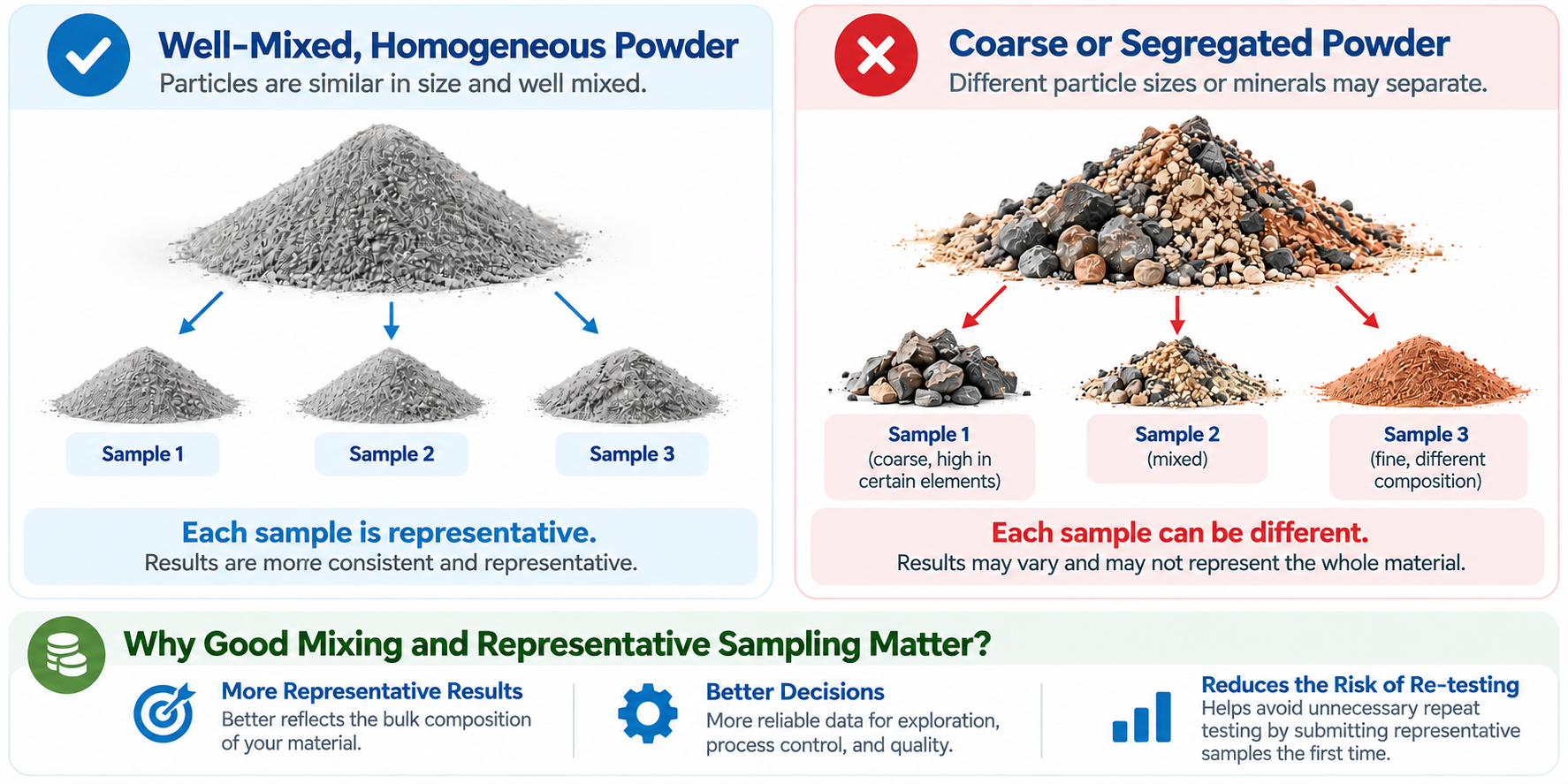
- Homogeneous powder: about 1–2 g.
- Heterogeneous ore, mineral, or concentrate: about 5 g or more may be appropriate.
- Send samples in a clean, sealed, clearly labeled container.
How Powder Results Are Interpreted
Analysis uses the Thermo Scientific ARL QUANT’X benchtop EDXRF system. Quantitative confidence depends on matrix, concentration, particle size, homogeneity, preparation, and calibration. Standardless Fundamental Parameters analysis is useful for screening and comparison; tighter quantitative requirements may require matrix-specific standards or another analytical method.
Batch and Lot Comparison
Consistent preparation makes XRF useful for comparing suppliers, production lots, and development batches and for identifying chemistry differences or outliers before more specialized testing is considered.
Industry Workflows for Powder Samples
Graphite & Carbon — supplier lots, purification stages, recovered graphite, ash, and contamination screening.
Mining & Mineral Processing — ores, concentrates, tailings, and prepared laboratory screening alongside field pXRF and selected confirmatory assays.
Catalyst & Metal Recovery — powders, fines, ash, sludge, filter cake, and process residues.
Industrial Minerals — supplier qualification, lot comparison, recycled mineral streams, and off-spec troubleshooting.
Related Powder Guidance
XRF Sample Preparation for Powders · How Accurate Is XRF Analysis? · XRF Sample Submission & Shipping · XRF Testing FAQ · XRF Testing Cost
Testing several samples? See XRF Testing Cost to understand when economical screening may be enough before higher-cost follow-up analysis.