XRF Testing Services
Choose the XRF service that best matches your material. Rapid Analytical provides mail-in EDXRF testing for powders, metals, minerals, ceramics, coatings, residues, and other inorganic materials.
Need to understand pricing first? See XRF Testing Cost & when screening makes sense →
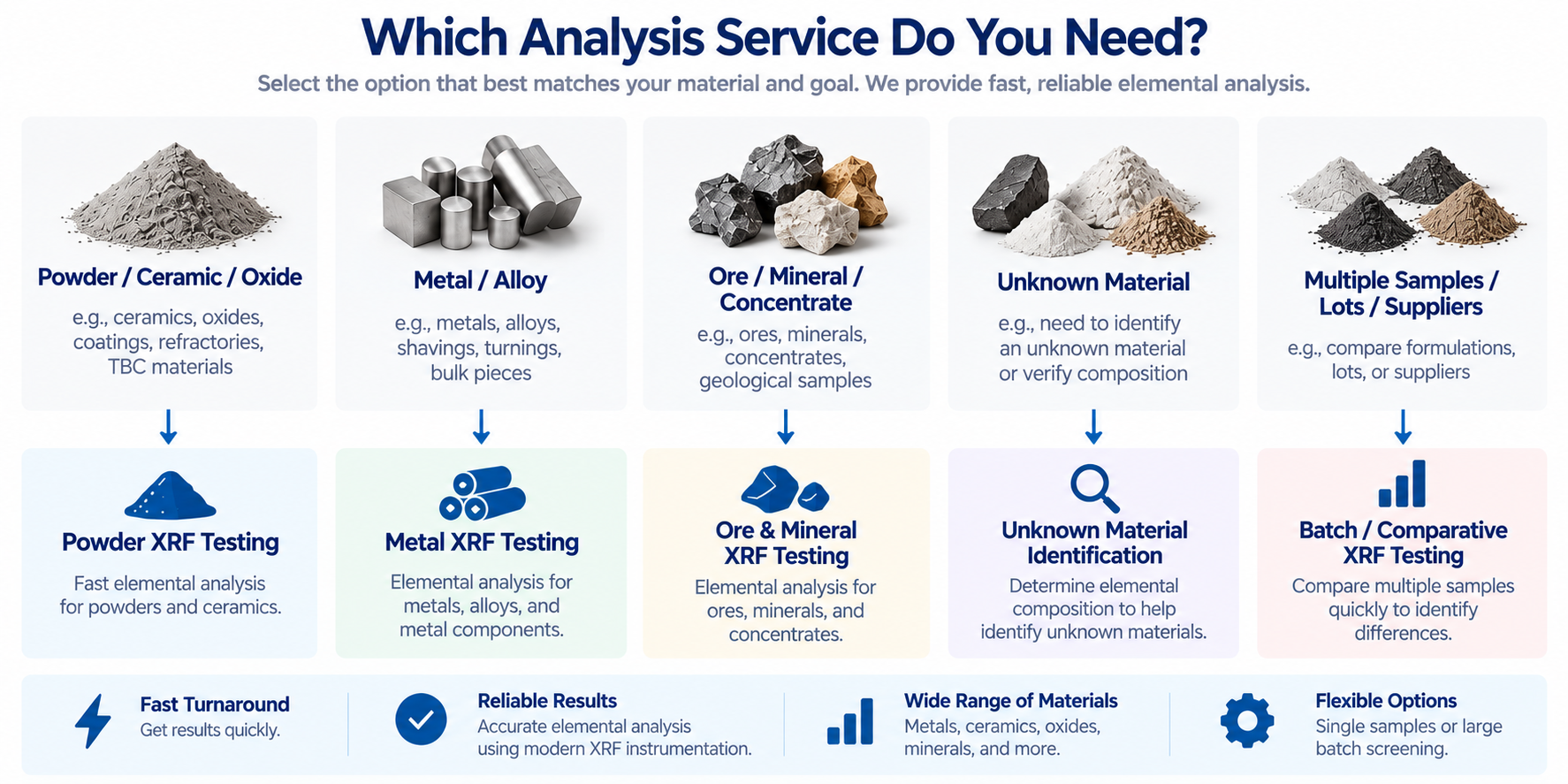
Open the full-size service guide
When Rapid Analytical Is a Good Fit
Best suited for: screening, supplier and lot comparison, R&D, incoming-material checks, unknown-material evaluation, and process decisions when accredited certification is not required.
For larger sample sets: screen broadly, identify differences or outliers, and use higher-cost confirmatory or accredited testing only where needed.
XRF Service FAQ
What does the standard $45 service include?
Standard testing includes laboratory EDXRF measurement, scientist review, and a PDF report by email. More complex projects can be scoped separately when sample handling or reporting needs differ.
Can multiple samples be compared as one project?
Yes. Batch testing is available for supplier lots, production samples, process stages, exploration sets, and recurring quality checks.
When should another analytical method be used?
Ultra-trace targets, certified compliance work, total carbon or LOI, phase identification, or other specialized requirements may need ICP, combustion, XRD, fire assay, or another method. See XRF vs ICP-OES / ICP-MS and the XRF Testing FAQ.
Method & Limitations
Testing is performed using a vacuum-enabled Thermo Scientific ARL QUANT’X EDXRF spectrometer with excitation conditions selected for the sample and analytical objective. Quantitative performance depends on factors such as matrix, homogeneity, particle size, surface condition, geometry, preparation, and calibration.
For accuracy, trace-level work, carbon, LOI, compounds, coatings, and accreditation questions, see the XRF Testing FAQ and XRF Accuracy & Limitations. For quantities, preparation, labeling, and packaging, see XRF Sample Submission & Shipping.
Choose the Right XRF Service
Start with the material type below. Each service page explains common applications, sample considerations, and method fit.
Powders & Industrial Materials
For powders, ash, residues, process materials, mixed inorganic solids, and routine material comparisons.
View Powder XRF →Metals & Alloys
For alloys, metal pieces, shavings, prills, buttons, jewelry, and metallic unknowns.
View Metal XRF →Ceramics & Oxides
For ceramic powders, oxide blends, refractories, pigments, and other inorganic oxide materials.
View Ceramics & Oxides →Ores, Minerals & Concentrates
For mineral-rich materials where representative sampling and heterogeneity are especially important.
View Ores & Minerals →Unknown Materials
For broad elemental screening when the composition is uncertain and the goal is to identify likely elements or material families.
View Unknown Material Identification →Batch & Recurring XRF
For supplier lots, production samples, process stages, exploration sets, and recurring quality checks.
View Batch & Recurring XRF →