XRF Detection Limits: ppm, wt%, and What “Detected” Means
Can XRF measure an element at 10 ppm, 100 ppm, or 1 wt%? It depends on the element, material, and method. There is no single detection limit that applies to every sample. This guide explains the numbers on an XRF report—and what to check before ordering testing for a low-concentration element.
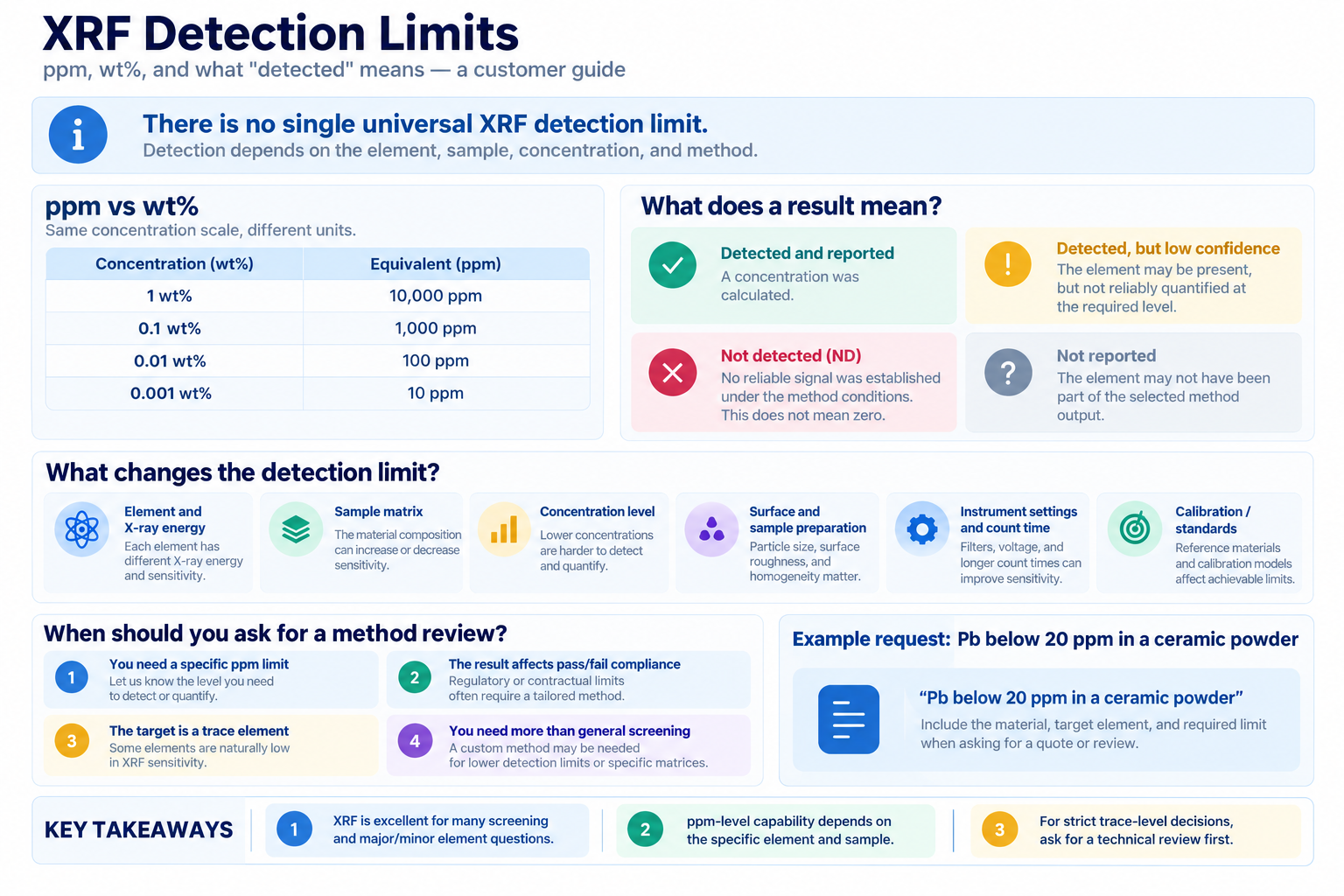
View full-size XRF detection-limit infographic (zoom to read)
Need to verify a specific ppm threshold? If your result must meet a requirement such as Pb below 20 ppm in a ceramic powder, request a method review before ordering. Detecting an element is not the same as establishing compliance with a numerical limit. Include your material, target element, specification threshold and expected concentration.
How to Interpret Your XRF Report
ppm and wt% describe the same mass fraction: 1 wt% = 10,000 ppm. The infographic above shows sample conversions and the differences between an element being detected, not detected, or not reported.
Important: “Not detected” does not mean zero, while an element omitted from a report may not have been included in the selected analysis. Detecting an element also does not establish quantitative accuracy.
LOD and LOQ: Two Different Questions
The limit of detection (LOD) concerns the smallest signal or concentration that can be distinguished from the blank/background with a defined confidence criterion. The limit of quantification (LOQ) concerns the lowest level that can be measured with suitable quantitative performance for the intended purpose. A reported LOD or LOQ is meaningful only when its basis and method are specified.
Example: If the question is “Is lead present?” a screening measurement may be useful. If the question is “Is lead below a 20 ppm specification?” the method must be demonstrated suitable around 20 ppm in that material. A general claim that an XRF instrument can detect ppm-level elements is not enough to establish compliance.
What Changes the Detection Limit?
Several factors determine whether a trace element can be measured reliably:
- Element and X-ray energy: fluorescence strength and absorption differ by element.
- Sample matrix: surrounding elements may absorb or enhance the measured signal.
- Spectral background and overlaps: interference can obscure a small peak.
- Instrument settings: excitation voltage, filters, atmosphere, and measurement time change signal quality.
- Sample preparation: surface coatings, particle size, sample thickness, and homogeneity can affect the measured composition.
- Calibration and validation: standards and checks are essential when a numerical acceptance threshold matters.
Longer counting times can improve counting statistics, but they do not eliminate all sources of analytical bias. For more detail, see How Accurate Is XRF Analysis? and XRF Sample Preparation for Powders. For published ppm examples showing how matrix and instrument conditions affect handheld measurements, see Handheld XRF vs. Benchtop XRF.
Why Published Detection-Limit Tables May Not Apply to Your Sample
Thermo Fisher has published ARL QUANT’X detection limits for particulate matter collected on air filters. That application uses specific excitation conditions and reports limits in surface-loading units such as ng/cm². Those figures cannot be copied directly as ppm-by-mass limits for bulk powder, jewelry, alloy, mineral, or ceramic samples.
Likewise, a manufacturer’s stated elemental range does not promise that every element can be quantified at the same ppm level. For more on which elements can be analyzed, see What Elements Can XRF Detect?.
When Should You Request a Method Review?
Rapid Analytical’s standard benchtop EDXRF service is useful for elemental screening, unknown-material comparison, and many major- and minor-element questions. A standard screening report should not automatically be treated as a certified trace-level compliance assay. If the decision depends on a specific ppm threshold, request a technical review before ordering; ICP-OES or ICP-MS may be more appropriate in some cases.
When asking about a trace element, include the target element, sample material, expected concentration, and decision limit (for example, “Pb below 20 ppm in a ceramic powder”). These details are more useful than a general request for the instrument’s lowest possible detection limit. For samples suitable for standard elemental screening, review the mail-in XRF testing process and testing cost.
Technical References
- International Union of Pure and Applied Chemistry (IUPAC), Limit of Detection and Limit of Quantification, Gold Book.
- Thermo Fisher Scientific, Analysis of Air Filters Using the ARL QUANT’X EDXRF Spectrometer, Application Note AN41964. Application-specific detection-limit example; not a bulk-material specification.