XRF Testing FAQ
Answers to common questions about XRF elemental analysis, sample preparation, capabilities, limitations, pricing, and turnaround.
What does XRF measure?
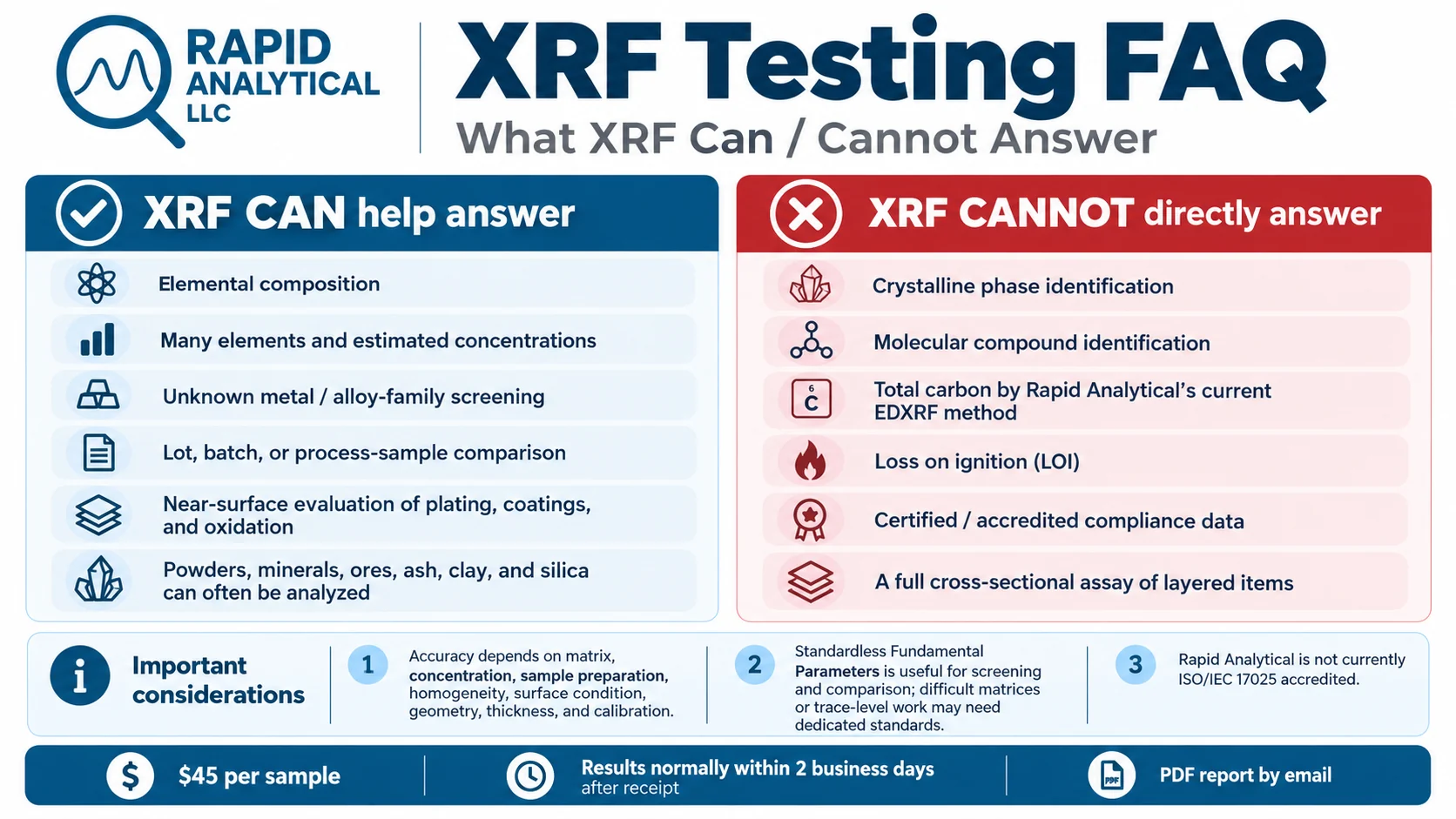
X-ray fluorescence (XRF) measures elemental composition. It can identify many elements and estimate their concentrations, depending on the element, matrix, concentration, sample preparation, and calibration.
Can XRF identify compounds or crystalline phases?
No. XRF primarily measures elements. It does not directly identify crystalline phases or molecular compounds. XRD is the appropriate comparison when the question is elemental chemistry versus crystalline phase or crystal structure. Another method may be required for molecular-compound identification.
Can XRF measure carbon?
Total carbon is not measured by the current EDXRF method used by Rapid Analytical. Combustion/LECO or another carbon-specific method is generally more appropriate.
Can XRF measure loss on ignition (LOI)?
No. LOI requires a separate gravimetric heat-treatment procedure and is not currently performed in-house.
Can you analyze powders, minerals, ores, ash, clay, or silica?
Yes. These are common EDXRF sample types. Homogeneity, particle size, mineral segregation, and sample preparation can affect quantitative accuracy. See XRF Powder Analysis for details.
Can you identify an unknown metal or alloy?
Often, yes. XRF can identify the metallic elements present in the measured area and provide composition estimates that may help determine whether a sample is consistent with a suspected alloy family.
Can XRF distinguish plating, gold-filled material, or coatings from bulk metal?
XRF is sensitive to the near-surface region, so plating, coatings, oxidation, and layered construction can affect the result. Different excitation conditions may provide useful comparative information, but XRF should not automatically be treated as a full cross-sectional assay of a layered item.
How much sample is needed?
Typical homogeneous powders need approximately 1–2 g. Metal shavings may need about 1 g. Heterogeneous mineral or ore samples may require approximately 5 g or more to improve representativeness. Loose powders do not need to be sent in an XRF cup. For solid pieces, a flat measurement face about 30 mm (1.18 in.) across or smaller is easiest to mount in the standard larger cup/holder. Larger objects may still be measurable by manual loading; send dimensions before shipping. See Sample Submission & Shipping for more guidance.
What affects XRF accuracy?
Accuracy can be affected by sample matrix, elemental concentration, particle size, homogeneity, surface condition, geometry, thickness, preparation, counting conditions, and calibration. Standardless Fundamental Parameters analysis is useful for broad screening and comparison, while application-specific calibrations or standards can improve quantitative accuracy for suitable materials and concentration ranges.
What instrument is used?
Rapid Analytical uses a Thermo Scientific ARL QUANT’X Energy Dispersive X-Ray Fluorescence (EDXRF) spectrometer with a silicon drift detector, multiple excitation filters, and Fundamental Parameters capability.
What do I receive?
A PDF analytical report is delivered by email with elemental composition, measurement uncertainty or error range where applicable, and instrument/method information.
How much does testing cost?
Standard XRF elemental analysis starts at $45 per sample. Larger recurring batches or unusual analytical scopes can be reviewed before shipment.
What is the turnaround time?
Standard results are normally provided within 2 business days after sample receipt.
Is Rapid Analytical ISO/IEC 17025 accredited?
No. Rapid Analytical is not currently ISO/IEC 17025 accredited. The service is designed for screening, comparative analysis, R&D, incoming-material checks, and process decisions where accredited certification is not required. This can be especially useful for evaluating many samples economically, identifying outliers or differences, and deciding which samples—if any—need higher-cost confirmatory or accredited testing. When regulatory, contractual, or certified compliance data is required, an appropriately accredited laboratory should be used.
Can I send a large batch or recurring samples?
Yes. Batch and recurring work is suitable for supplier comparisons, incoming lots, process-development samples, production checks, mineral sample sets, and other projects where multiple related samples need consistent screening. Label each sample with a unique ID and include a sample list for larger projects.
Can companies use purchase orders or request a quote?
Yes. Standard testing is $45 per sample, and written quotes or purchase-order workflows are available for larger, recurring, or custom-scope projects. Contact Rapid Analytical with the material type, number of samples, and the decision or comparison the testing needs to support.
Can multiple samples be included in one project or report?
Yes. Multiple samples can be organized by supplier, lot, process stage, condition, or project group and recorded systematically under unique sample IDs within one project or report. Customers can then review the reported elemental results for differences, trends, or outliers.
When should I contact Rapid Analytical before ordering?
Contact Rapid Analytical first for hazardous or regulated material, unusual geometry, highly heterogeneous samples, very low trace-level targets, layered materials, large recurring batches, or when the correct analytical method is uncertain.
Related services: XRF Powder Analysis · XRF Metal Analysis · Sample Submission & Shipping
Need help deciding whether XRF fits your sample?
Send the material type, approximate sample count, and what needs to be learned. Rapid Analytical can review method fit before anything is shipped.