Graphite Impurity Screening by XRF
Mail-in benchtop EDXRF screening of detectable inorganic impurities in graphite powders, purified graphite, ash, residues, and recovered graphite. Compare suppliers, production lots, and purification stages. This service does not measure total carbon content, graphite purity, or crystallinity.
Graphite Supplier Quality & Purification Screening
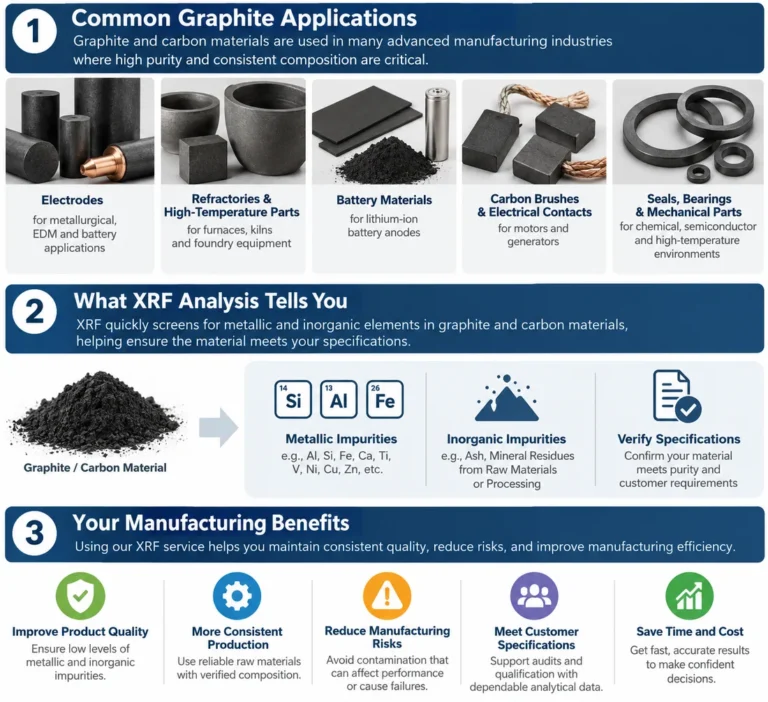
For graphite processors, raw-material buyers, recycling operations, and technical teams, XRF can help compare detectable inorganic elements in related samples. This is screening and process-support information, not a measurement of carbon purity.
- Compare suppliers and incoming lots: use consistent sample preparation to check for shifts in detectable elements and flag outliers for investigation.
- Screen purification stages: compare Fe, Ni, Cr, Cu, Ca, or other relevant elements when their concentrations are within the method’s suitable range.
- Review recovered graphite and ash: identify relevant inorganic differences among incoming feed, processed fractions, and residues; matrix effects and dilution can change apparent results.
- Choose samples for confirmatory analysis: XRF can guide which lots or stages need ICP-based impurity testing, carbon analysis, or other methods.
Preparing a Graphite Sample Set
Label each sample with a unique supplier, lot, or process-stage ID. Provide the graphite grade, target elements, estimated concentration range if known, and whether the material is powder, ash, or a solid. For meaningful comparisons, keep sampling and powder preparation consistent. Review sample preparation and shipping instructions.
Cost and project options: standard screening is $45/sample (5 = $225; 10 = $450; 25 = $1,125). Routine accepted graphite or ash samples, including multiple lots, can use standard ordering. For customized recurring programs, purchase orders, or uncertain impurity detection limits, request a technical review before ordering. See Batch & Recurring Testing and Pricing.
What This Service Does Not Replace
XRF does not directly measure total carbon, graphitization/crystallinity, particle size, BET surface area, or lithium. Ultra-trace impurity requirements may require ICP-based methods or another specialized technique. Rapid Analytical is not an ISO/IEC 17025-accredited laboratory; the standard service is intended for screening, comparison, R&D, and process support. For measurable impurities and practical concentration limits, see What Elements Can XRF Detect? and XRF Detection Limits.
Common Graphite XRF Decisions
Are supplier lots chemically similar?
Compare detectable elemental profiles under consistent sample preparation and measurement conditions.
Did purification reduce metallic impurities?
Track measurable Fe, Ni, Cr, Cu, or other impurities between related process stages.
Is recovered graphite different from incoming material?
Screen for shifts in inorganic elemental composition and possible contamination.
Which samples need deeper analysis?
Use initial screening to identify outliers for suitable ICP or other specialized follow-up methods.
XRF screens measurable inorganic elements; it does not quantify total carbon or graphite purity.
For the nationwide mail-in process, see Mail-In XRF Testing. For powder handling and preparation effects, see XRF Sample Preparation for Powders. For uncertainty and matrix effects, see How Accurate Is XRF Analysis?.
Graphite XRF FAQ
Can XRF measure the carbon content of graphite?
No. Standard XRF is used here to evaluate detectable inorganic elements; it does not directly quantify total carbon or graphitization.
Can XRF compare iron or other metallic impurities between lots?
Often yes, provided the element is detectable at the concentration of interest and the samples are prepared and measured consistently. Quantitative performance remains matrix- and sample-dependent.
Is graphite batch testing available?
Yes. Supplier lots, purification stages, recovered material, ash, and recurring QC sets can be submitted together. See Batch & Recurring XRF Testing.