XRF Analysis of Ores, Minerals and Concentrates
Mail-in benchtop EDXRF analysis for ores, minerals, concentrates, tailings, and related geological materials. XRF is useful for rapidly screening sample sets, comparing chemistry, and identifying samples that may warrant additional testing.
Representative Sampling Matters
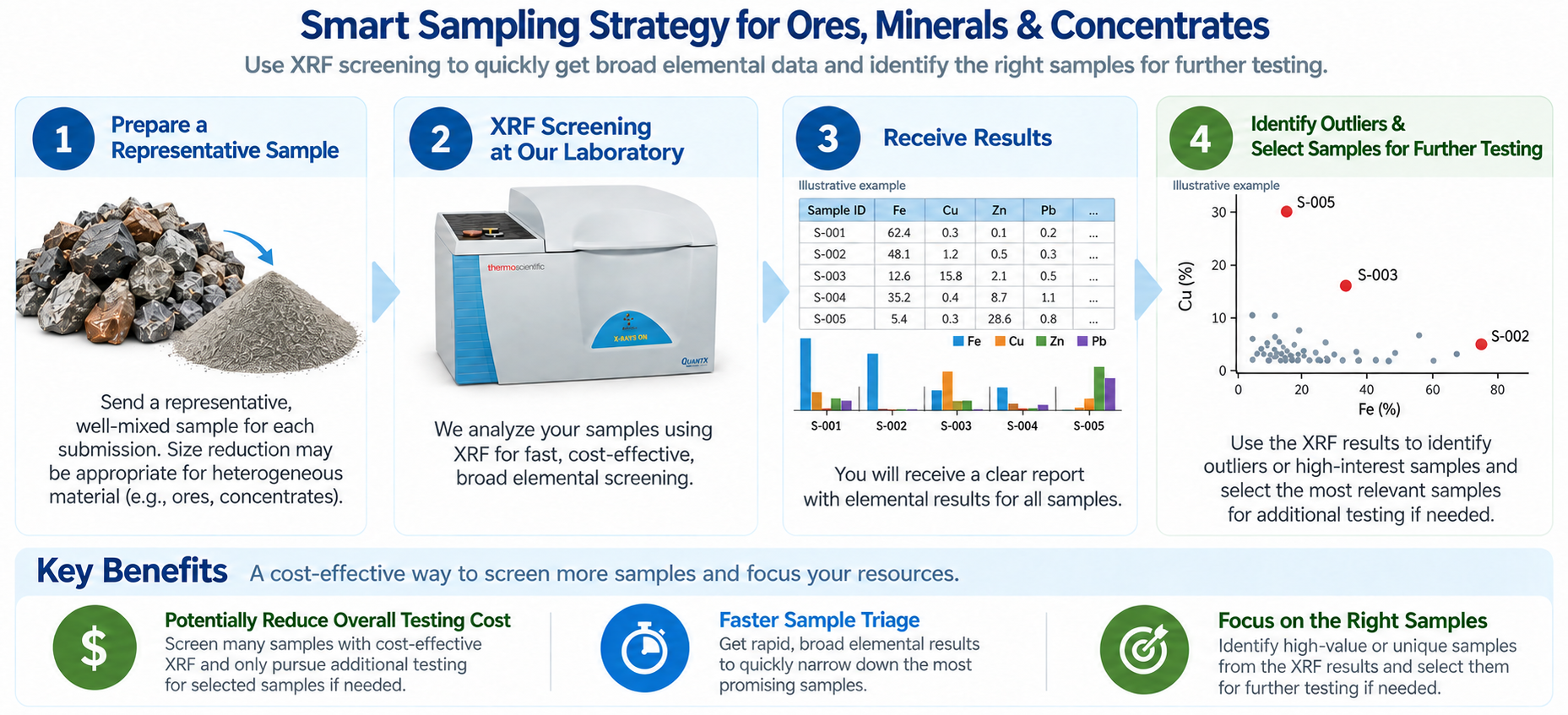
Ores, minerals, and concentrates can be highly heterogeneous. Coarse grains, density segregation, and uneven mineral distribution can make a small portion unrepresentative of the bulk. Heterogeneous material may therefore require about 5 g or more, compared with roughly 1–2 g for a fine homogeneous powder.
What XRF Can and Cannot Tell You
XRF measures elemental composition and is useful for screening, comparison, and identifying unusual or high-interest samples. It does not directly identify crystalline mineral phases. If the question is hematite vs. magnetite, or another phase distinction, see XRF vs XRD to understand when diffraction is the more appropriate technique.
Quantitative confidence: Particle size, homogeneity, packing, matrix effects, and calibration all influence results. Standardless Fundamental Parameters analysis is especially useful for screening and comparison rather than certified ore assay.
A Practical Exploration & Process-Screening Workflow
Field pXRF → prepared laboratory EDXRF → selected samples to ICP / fire assay / full commercial assay
Portable XRF can be very useful for field decisions. Laboratory EDXRF adds controlled sample preparation and geometry, optimized excitation conditions, longer measurement time, and consistent comparison of prepared samples. It can help narrow a larger sample set before the highest-value or most decision-critical samples are sent for more specialized or certified analysis.
This workflow is especially relevant for drilling programs, metallurgical testwork, concentrates, beneficiation, tailings, and other projects that generate repeated sample sets.
Not a Certified Settlement Assay
Rapid Analytical is not an ISO/IEC 17025-accredited laboratory. The standard service is intended for screening, comparison, R&D, and process support. Projects requiring certified assay, regulatory data, or final commercial settlement values should use an appropriately qualified laboratory and method.
Common Mining & Mineral Decisions
| Objective | Practical Use of XRF |
|---|---|
| Exploration screening | Compare prepared samples and identify anomalous elemental patterns for follow-up. |
| Ore / concentrate comparison | Evaluate relative chemistry among lots, process streams, or beneficiation conditions. |
| Supplier or source comparison | Screen for major elemental differences under a consistent laboratory workflow. |
| Triage before assay | Narrow a larger sample set before selected certified or destructive confirmatory analysis. |
Mining XRF FAQ
Can XRF replace a certified ore assay?
No. The standard service is intended for screening, comparison, R&D, and process support. Commercial settlement, regulatory, or certified assay requirements should use an appropriately qualified method and laboratory.
Why does representative sampling matter so much for ores?
Mineral and ore samples can be heterogeneous. A small measured portion may not represent the bulk material unless sampling, homogenization, and preparation are appropriate.
Can a large exploration set be screened first and selectively assayed later?
Yes. That is a practical use of XRF when the goal is to identify patterns or outliers and reserve higher-cost confirmatory testing for selected samples.
Sample Submission
For heterogeneous material, send a representative, well-mixed sample. General quantities, labeling, and packaging guidance are listed on XRF Sample Submission.
Screening a sample set? See XRF Testing Cost for how low-cost screening can help narrow which samples need deeper analysis.