Industrial Minerals XRF Screening
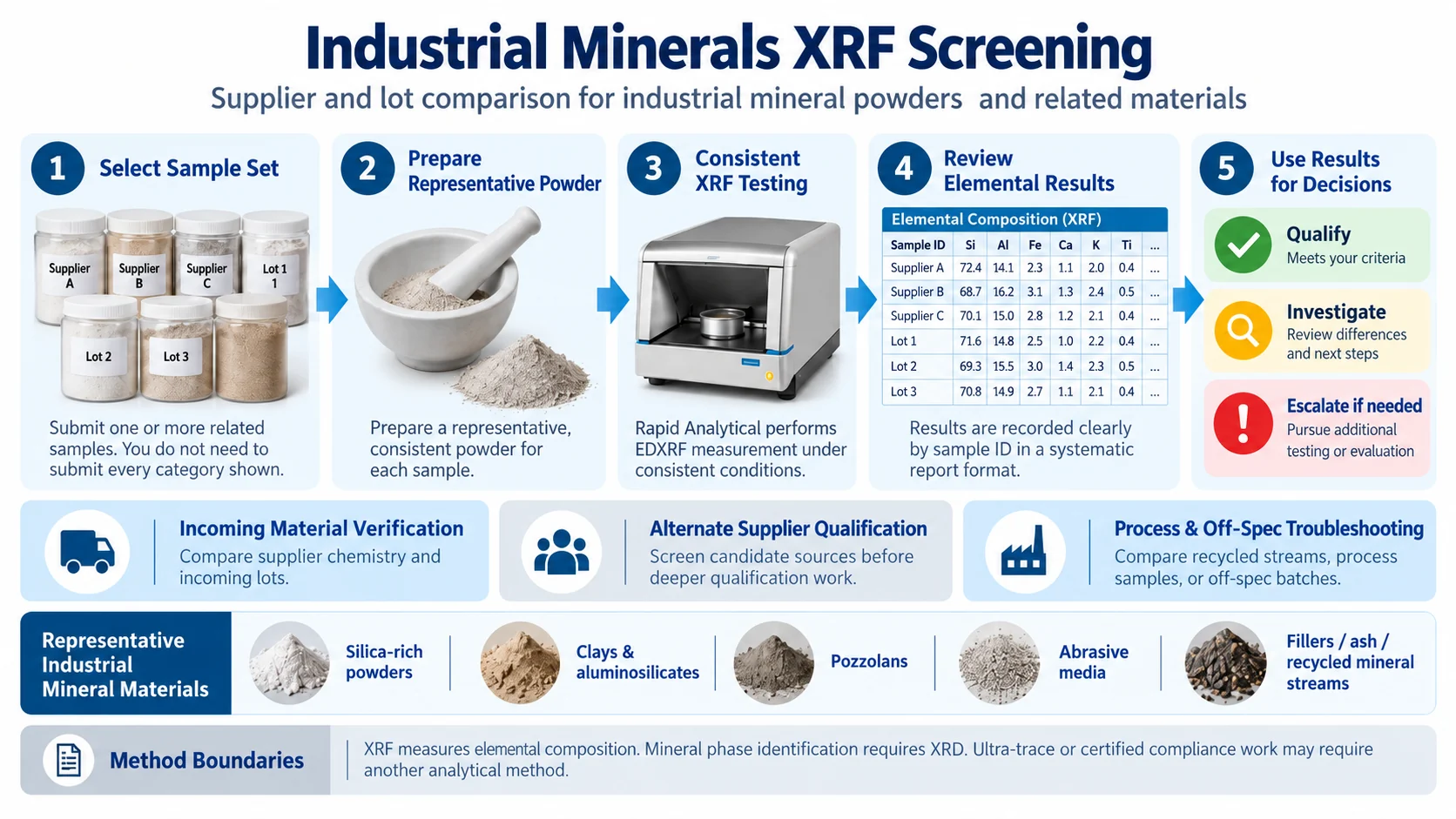
Mail-in EDXRF screening for mineral powders, fillers, abrasives, clays, silica-rich materials, pozzolans, and other inorganic industrial minerals. Submit one sample or a related set from different suppliers, lots, process stages, or conditions. Results provide elemental information customers can use for supplier qualification, incoming-lot comparison, troubleshooting, and recurring material checks.
Industrial Mineral Supplier & Lot Decisions
Use a comparable series of elemental results to support incoming material screening, alternate-source evaluation, process-troubleshooting, and repeat QC. The suitability of a particular element or limit must be checked against the material matrix and analytical method.
- Abrasive and blasting media: compare detectable Fe, Al, Si, Cr, Ti, Zr or other elements relevant to the product specification; surface and grain effects may require additional preparation.
- Clays and aluminosilicates: compare supplier/lot elemental trends such as Si, Al, Fe, K, Ca and Ti without equating composition with mineral phase.
- Silica, fillers and mineral additives: look for detectable inorganic composition changes or impurities in incoming powder lots, subject to detection limits.
- Recycled minerals and process residues: screen incoming fractions and process stages for notable elemental differences before selecting samples for confirmation.
How to Submit a Mineral Comparison
Provide unique sample IDs, material name, supplier/lot or process stage, approximate particle size, and target elements or acceptance questions. Send representative samples prepared as consistently as practical. See sample amounts and shipping guidance.
Standard screening: $45/sample; 5 = $225, 10 = $450, 25 = $1,125. For recurring testing, special preparations, or a purchase-order workflow, request a technical quote. XRF reports elemental data; phase analysis (XRD), LOI, ultra-trace or compliance work may require other methods.
Representative Materials
- Silica and silica-rich powders
- Clays and aluminosilicate minerals
- Pozzolans and mineral additives
- Abrasive and blasting-media materials
- Fillers, mineral powders, ash, and recycled mineral streams
Results & Method Considerations
Each submitted sample is measured and reported under its own sample ID. For related supplier, lot, or process samples, consistent sample preparation improves comparability, and results can be organized systematically within one report.
XRF measures elemental composition. Quantitative performance depends on matrix, particle size, homogeneity, concentration range, preparation, and the selected method or calibration. Mineral phase identification requires XRD, while ultra-trace or certified compliance work may require another method or an accredited laboratory. For the element range and testing feasibility, see What Elements Can XRF Detect?. For trace elements or specified ppm thresholds, see XRF Detection Limits.