XRF vs ICP-OES / ICP-MS for Elemental Analysis
XRF, ICP-OES, and ICP-MS answer different elemental-analysis questions. XRF is often an efficient first step for broad screening of solids and powders, while ICP methods are better suited when very low trace levels or solution-based quantitative analysis are required.
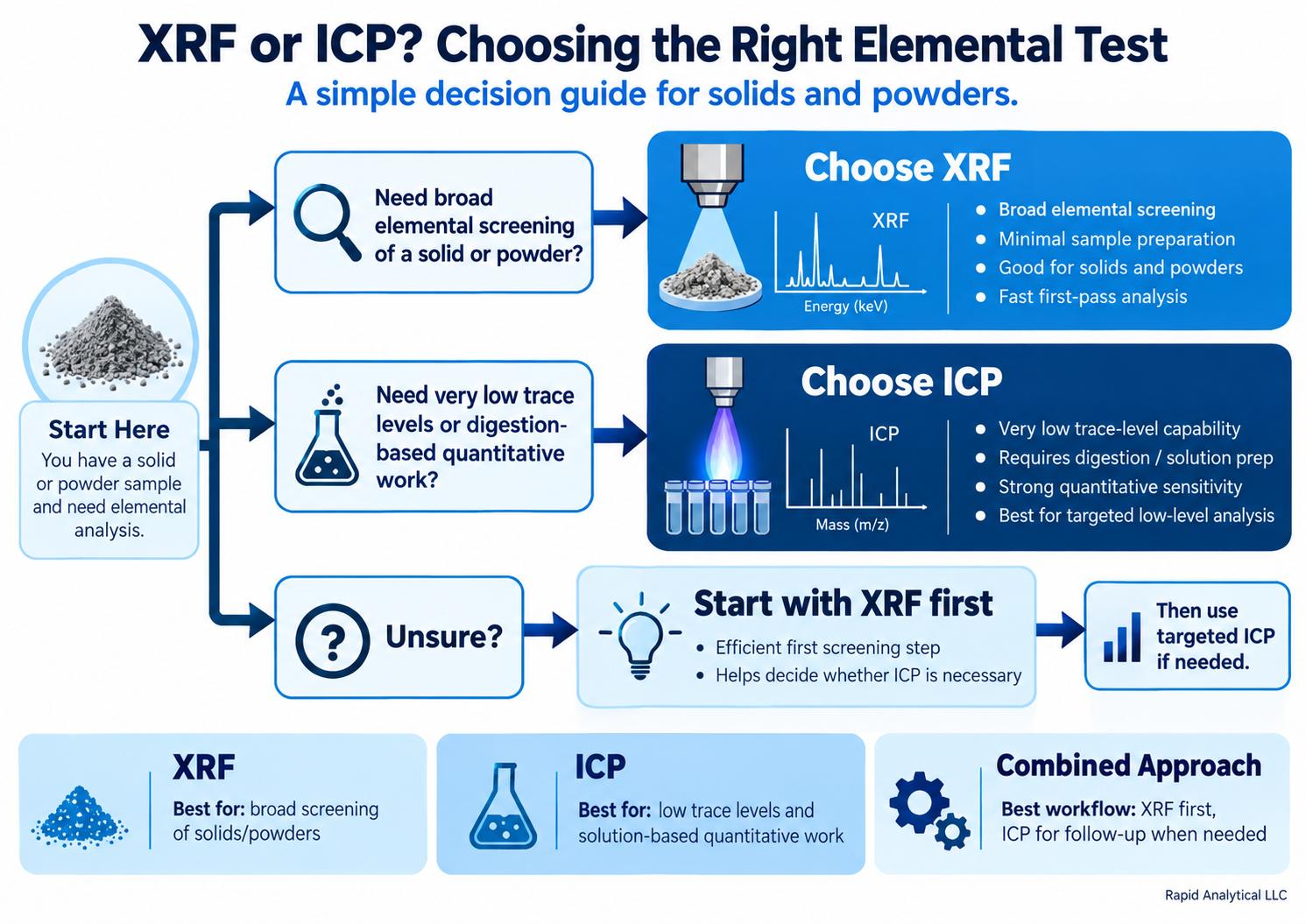
XRF vs. ICP: Side-by-Side Comparison
The best method depends on the question, the sample matrix and the concentration you need to measure. This is a practical comparison, not a universal detection-limit specification.
XRF / EDXRF
A practical first step for elemental screening of solids, powders and material comparisons.
Characteristic X-rays from elements in the analyzed region.
Many solids and powders can be measured directly with suitable sample preparation.
Usually nondestructive for suitable solid specimens.
Sensitivity depends strongly on the element, matrix and measurement method.
ICP-OES
Useful for validated quantitative multi-element analysis over suitable concentration ranges.
Light emitted by excited atoms and ions in a plasma.
Usually needs a prepared solution, often after dissolution or digestion.
Typically consumes the sample portion prepared for analysis.
Often more suitable than routine XRF screening for lower concentration requirements.
ICP-MS
Often selected for very low trace and ultra-trace elemental requirements.
Ions separated by mass-to-charge ratio.
Usually needs a prepared solution, often after dissolution or digestion.
Typically consumes the sample portion prepared for analysis.
Very low concentration capability; interference and preparation must be controlled.
No technique has one universal detection limit or accuracy level. The method must be suitable for the specific element, sample and intended decision.
When Is XRF the Better Starting Point?
XRF is often practical when the goal is to identify measurable elements or compare materials without immediately requiring trace-level certification. Common questions include:
- Are two supplier powder lots similar in elemental composition?
- Which measurable elements are present in an unknown alloy or mineral?
- Which incoming feed or processing residues contain higher concentrations of target metals?
- Which samples in a larger set merit more specialized follow-up analysis?
Example: XRF screening of ten mineral samples may identify compositional differences and help prioritize which specimens need a more specific quantitative assay. Screening does not replace the assay if the final decision requires one.
When Should ICP-OES or ICP-MS Be Considered?
Consider an ICP-based method when an acceptance decision depends on a low trace concentration or validated quantitative performance, or when the required method is specified by a regulation or contract.
Example: A ceramic powder must meet a limit of less than 20 ppm lead. Showing that lead can sometimes be detected by XRF is not enough; the selected method must perform adequately near 20 ppm in that ceramic matrix. ICP-OES or ICP-MS may be more appropriate, depending on the requirement.
ICP testing is not automatically accurate for every material. Incomplete dissolution of refractory ceramics or minerals, contamination, matrix effects and spectral interferences can affect results. An appropriate laboratory should select and validate the preparation and measurement method.
For the difference between detection and quantification, see XRF Detection Limits: ppm, wt%, and What “Detected” Means.
Can XRF and ICP Be Used Together?
- Screen: Measure suitable samples by XRF to compare broad elemental composition.
- Select: Identify the specific samples, elements or thresholds requiring closer examination.
- Confirm: Use an appropriately validated ICP method or other specialized test where required.
For supplier qualification, process development, mineral screening and metal recovery, this approach can help focus more expensive follow-up testing. Whether it saves money depends on sample count, the decision and the additional laboratory costs.
What Does Rapid Analytical Provide?
Rapid Analytical provides benchtop EDXRF analysis, not ICP-OES or ICP-MS testing. The standard XRF service is $45 per accepted sample for suitable screening applications. If a method specification requires ICP, use a laboratory equipped and qualified for that method.
Choose XRF for elemental screening and material comparison. Request a method review before ordering if a particular ppm threshold, highly heterogeneous material or certified result is essential. Include the material, target elements, expected concentrations and decision limit.
Related guides: What Elements Can XRF Detect? · How Accurate Is XRF Analysis? · Mail-In XRF Testing · XRF Testing Cost.
Need help deciding whether XRF fits your sample?
Send the material type, approximate sample count, and what needs to be learned. Rapid Analytical can review method fit before anything is shipped.