
How Accurate Is XRF Analysis?
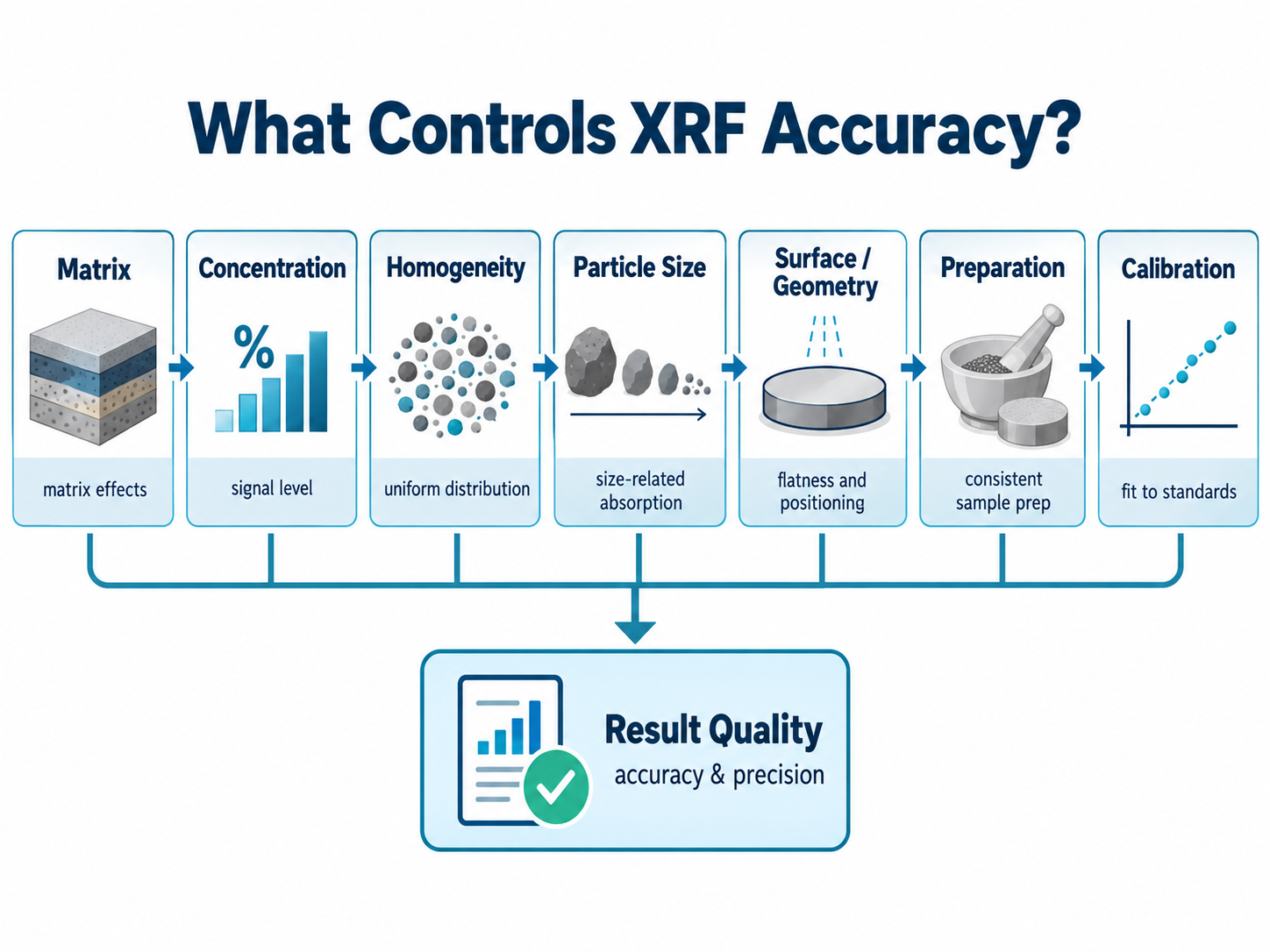
XRF can provide useful qualitative and quantitative elemental information, but accuracy is not a single fixed number. It depends on the element, concentration, sample matrix, preparation, calibration approach, geometry, and how representative the measured region is.
Accuracy vs. Precision: A Worked Example
Precision describes the agreement between repeat measurements; bias describes the systematic difference from a reference value. A precise XRF result can still be inaccurate. Consider this hypothetical example for a certified material containing 5.00 wt% Ni:
| Metric | Illustrative result |
|---|---|
| Reference concentration | 5.00 wt% Ni |
| Five replicate readings | 4.78, 4.79, 4.80, 4.81, 4.82 wt% |
| Mean concentration | 4.80 wt% |
| Repeatability (sample RSD) | 0.33% |
| Relative bias | −4.0% |
The readings are tightly grouped, but their mean is 0.20 percentage points below the reference: relative bias = (4.80 − 5.00) / 5.00 × 100 = −4.0%. The 0.33% RSD describes only these repeat readings, not overall method accuracy or uncertainty. No universal XRF accuracy percentage applies to every element and matrix. See the Eurachem method-validation guide (2025).
What Changes XRF Accuracy?
- Sample matrix and calibration: neighboring elements change absorption and enhancement of fluorescence. Fundamental Parameters (FP) corrections help, but matrix mismatch may still cause bias (J. Chem. Educ., 2019).
- Powder sampling and preparation: particle size, mixing, moisture, packing, and the representativeness of the tested portion affect results. A soil study found that dried, ground, pressed samples often agreed better with benchtop XRF than field-moist measurements (Goff et al., 2020).
- Element and concentration: spectral overlaps and background complicate peak fitting. Results near the detection or quantification limit are less suitable for precise numerical decisions. Longer counting reduces counting noise but not systematic error.
- Geometry and surfaces: coating, corrosion, roughness, curved metal surfaces, and heterogeneous particles can make the analyzed region unrepresentative of the bulk sample.
How Is Quantitative Accuracy Verified?
A strong verification approach measures a matrix-matched certified reference material (CRM) or an independent check standard, ideally not used to establish the calibration. Compare the measured mean with its assigned value and uncertainty, examine replicate precision and bias, and use acceptance criteria appropriate to the customer’s decision. Replicate scans of one cup test instrumental repeatability; independently prepared aliquots also test preparation variability. See Eurachem, Selection and Use of Reference Materials.
For Rapid Analytical: ARL QUANT’X benchtop EDXRF supports practical elemental screening. Quantitative confidence depends on the specific sample, element, method, and available verification data; an instrument-generated statistical error alone is not a validated total measurement uncertainty. Measurement error or uncertainty information is reported where applicable. No fixed ±% accuracy or certified compliance is implied.
Screening vs. Higher-Accuracy Quantitative Work
Standardless or Fundamental Parameters methods are useful for screening, supplier comparison, lot-to-lot checks, unknown-material evaluation, and R&D. When tighter quantitative agreement is required, matrix-specific calibration and appropriate reference materials may be needed. See Standardless XRF / Fundamental Parameters.
Is XRF Accurate Enough for Your Decision?
| Customer question | Recommended approach |
|---|---|
| What are the major elements in my powder or alloy? | Benchtop EDXRF is often a good first screening method for suitable inorganic samples. |
| Are two supplier lots different? | Compare representative samples under consistent conditions; differences should exceed analytical and sampling variability. |
| Is the composition exactly 8.0 wt% Y₂O₃? | Quantitative confidence requires suitable calibration/reference checks; reported oxide equivalents do not establish crystal phases. |
| Is Pb below a strict 10 ppm limit? | Review matrix-specific detection/quantification capability and uncertainty before ordering. Another method may be needed. |
Related guides: Powder Sample Preparation, Metal Analysis, XRF FAQ, Measurable Elements, Detection Limits, and Handheld vs. Benchtop XRF.
Technical references: IAEA — Fundamentals of XRF Analysis ↗
Need help deciding whether XRF fits your sample?
Send the material type, approximate sample count, and what needs to be learned. Rapid Analytical can review method fit before anything is shipped.