XRF Powder Analysis
Mail-in benchtop EDXRF elemental analysis for metal powders, ceramic and oxide powders, industrial minerals, ash, and other suitable inorganic materials. Rapid Analytical helps screen elemental composition, compare suppliers and production lots, investigate detectable impurities, and support materials R&D.
$45 per accepted sample · Scientist-reviewed PDF report · Results normally within 2 business days after sample receipt.
Order Standard XRF Analysis · Request a Technical Review for unusual materials or specific analytical limits.
What Can Powder XRF Tell You?
The useful result depends on the elements, their concentrations, the powder matrix, and how representative the measured portion is. XRF can help answer:
- Which elements are present? Identify measurable elements and estimate their concentrations in wt% and/or ppm where appropriate.
- Are two suppliers or lots similar? Compare detectable elemental profiles when sampling, preparation, and measurement conditions are consistent.
- Are there measurable impurities? Screen for selected inorganic or metallic elements, such as Fe, Cr, Ni, or other relevant targets, when detectable in the matrix.
- Did processing change the composition? Compare suitable raw-material, process-stage, and development samples for chemistry differences.
- Does a powder meet a strict ppm specification? Request a method review before ordering; detection alone does not establish a quantitative pass/fail result.
Powder Types We Analyze
- Metal powders and blends: suitable elemental composition and lot-comparison screening.
- Ceramic and oxide powders: raw materials, oxide blends, and measurable dopants or contaminants.
- Industrial minerals and fillers: prepared clays, silica-rich powders, and mineral feedstocks.
- Ash, fines, and process residues: inorganic elemental screening after any needed sample-suitability and hazard review.
For more specific materials, see Ceramics & Oxides and Ores & Minerals.
Sample Preparation & Representative Sampling
Particle size, segregation, packing, and differences between subsamples can affect powder XRF results. A well-mixed, representative specimen is particularly important when comparing supplier lots or manufacturing conditions.
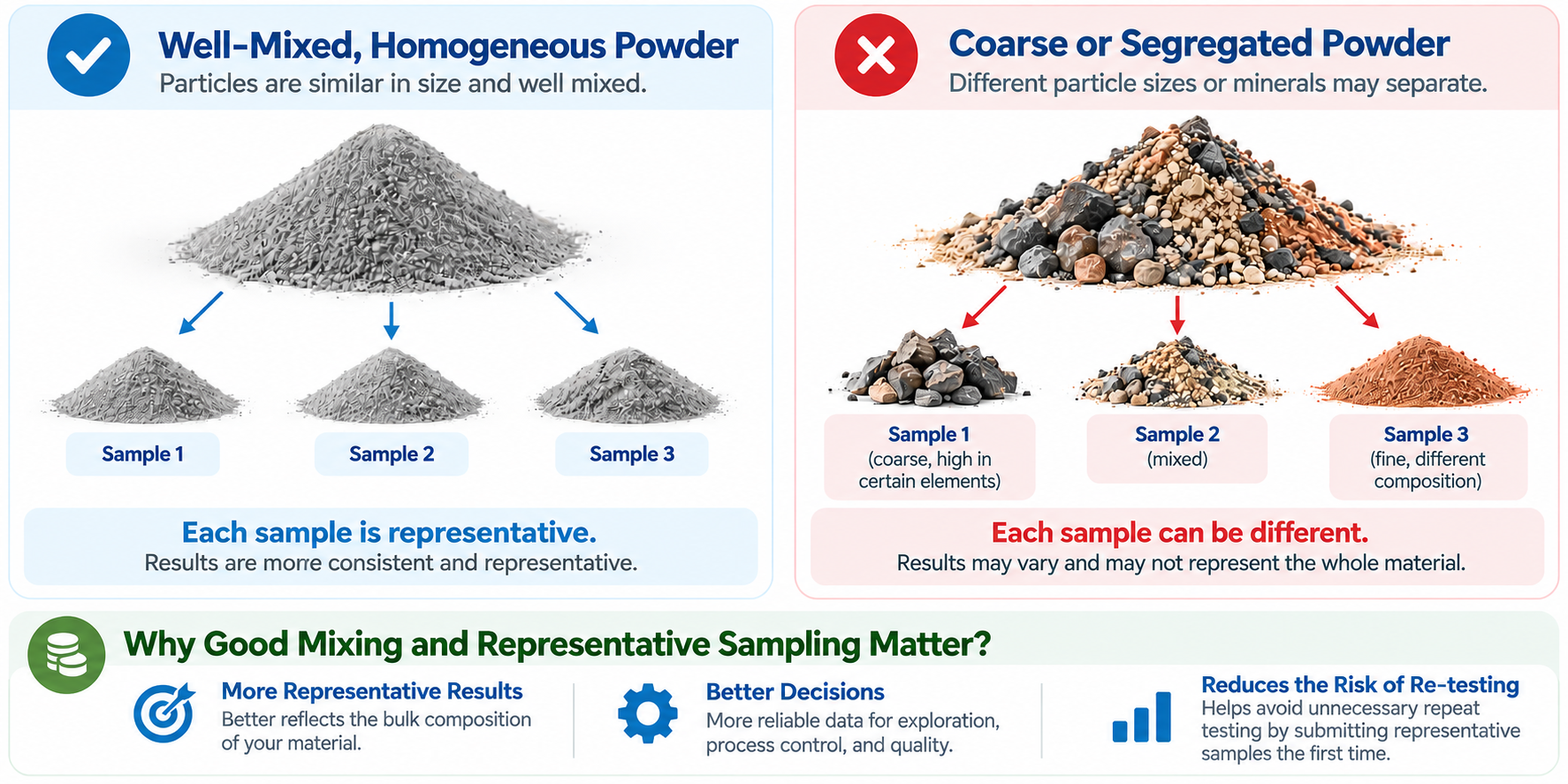
Sampling principle: Well-mixed powder is generally more representative than visibly segregated powder. Representative sampling improves comparisons but does not remove matrix or calibration effects.
Sample Amounts & Handling
- Fine, relatively homogeneous powder: approximately 1–2 g is typical.
- Coarse or heterogeneous ore or mineral: approximately 5 g or more may be appropriate; this alone does not guarantee a representative subsample.
- Packaging: use a clean, sealed, labeled container. Avoid tools or containers that may introduce the elements being measured.
Not every powder needs milling before screening. Contact Rapid Analytical before sending hazardous, reactive, unfamiliar, or potentially regulated powders or residues; written acceptance may be necessary. Review Powder Sample Preparation and Sample Submission before shipping.
How Powder Results Are Interpreted
Measurements use the Thermo Scientific ARL QUANT’X benchtop EDXRF system. Standard testing includes a scientist-reviewed PDF report with detectable elemental results, method information, and uncertainty or error information where applicable. Quantitative confidence depends on the element, concentration, powder matrix, preparation, homogeneity, and calibration. See Handheld XRF vs. Benchtop XRF for the practical differences in powder measurement and method selection.
Standardless Fundamental Parameters methods can support screening and comparison, but do not automatically establish matrix-validated accuracy. This XRF service does not directly measure total carbon, oxygen, loss on ignition (LOI), or crystalline phases; oxide-equivalent results, if reported, are calculated rather than direct oxygen or phase measurements. Review measurable elements and detection limits if the decision depends on a specific element or concentration.
Batch and Lot Comparison
For supplier, incoming-material, or development comparisons, label each sample with a unique supplier, lot, or condition ID and provide a matching sample list. Using suitably consistent preparation and measurement conditions helps make elemental differences easier to interpret. Routine accepted samples remain $45 each; larger sample counts alone do not require a custom quote. For purchase orders, specialized methods, or recurring programs, see Batch & Recurring XRF Testing.
Industry Workflows for Powder Samples
Graphite & Carbon — supplier lots, purification stages, recovered graphite, ash, and contamination screening.
Mining & Mineral Processing — ores, concentrates, tailings, and prepared laboratory screening alongside field pXRF and selected confirmatory assays.
Catalyst & Metal Recovery — powders, fines, ash, sludge, filter cake, and process residues.
Industrial Minerals — supplier qualification, lot comparison, recycled mineral streams, and off-spec troubleshooting.
Related Powder Guidance
Mail-In XRF Testing · XRF Sample Preparation for Powders · How Accurate Is XRF Analysis? · XRF Sample Submission & Shipping · XRF Testing FAQ · XRF Testing Cost · Which Elements Can XRF Detect? · Detection Limits & ppm Reporting
Ready to submit a powder? Routine suitable samples may be ordered online. For specified low detection limits, unusual material, or required certification, request a technical review before purchasing.