Batch & Recurring XRF Testing
For technical teams comparing multiple suppliers, lots, process stages, development samples, or recurring production materials. Rapid Analytical provides a simple $45/sample EDXRF workflow with results normally within 2 business days after sample receipt.
Standard pricing: $45 per sample
5 samples = $225 · 10 samples = $450 · 25 samples = $1,125. Written quotes and purchase-order workflows are available for customized recurring programs or special requirements; multiple routine accepted samples can use standard $45/sample checkout.
Good Fits for Batch Testing
Supplier & Lot Comparison
Compare incoming materials, alternate suppliers, or production lots under consistent laboratory conditions.
Process & Development Sets
Compare feed, intermediate, residue, formulation, or R&D samples to identify differences and outliers.
Recurring Quality Checks
Use repeatable elemental screening when a full in-house XRF laboratory or accredited certification is not required.
Repeat Orders & Lot-to-Lot Comparisons
For a repeat project, reference the earlier project or report ID and keep supplier, lot, condition and sample naming consistent. Include an updated sample list identifying any changed material or preparation conditions. Existing results may be useful as a comparison baseline, but suitability and method conditions should be confirmed for the new batch.
Example batch totals: 5 samples = $225, 10 = $450, and 25 = $1,125 at the standard $45/sample rate. Ask for a recurring-project quote or PO workflow when ongoing shipments are planned.
How to Submit a Batch
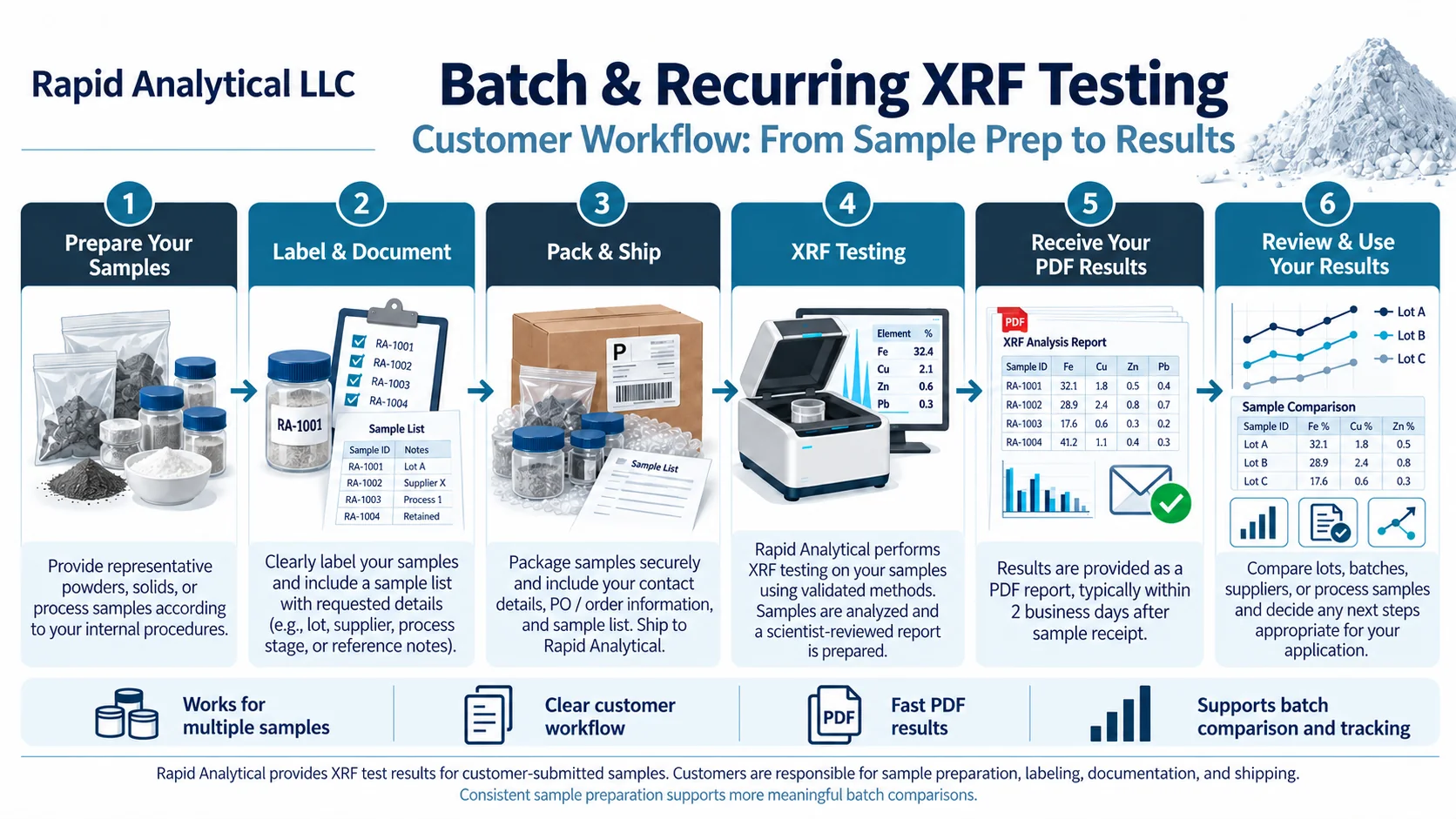
Customers prepare, label, and ship their own samples. Use a unique sample ID for every container and include a sample list showing supplier, lot, process stage, condition, or other grouping that matters to the comparison. See Sample quantities and preparation guidance.
Consistent preparation matters for comparisons.
Representative sampling, homogeneity, particle size, and surface condition can affect XRF results. For meaningful lot-to-lot or batch comparisons, prepare related samples as consistently as practical.
How Batch Results Are Organized
Supplier / lot comparison
Individual elemental results identified by supplier and lot sample IDs.
Process-development set
Results organized by feed, intermediate, product, residue, condition or experiment ID.
Exploration screening
Measurements reported by submitted sample ID and relevant project grouping.
Recurring quality checks
Consistent naming and practical measurement conditions support repeat comparisons.
Batch XRF FAQ
Is there a minimum batch size?
No special minimum is required. One or multiple accepted routine samples can use standard $45/sample checkout. Written quotes are available for purchase orders, custom analytical needs, or tailored recurring programs.
Will all samples be measured under the same conditions?
Comparable samples are measured under consistent XRF conditions where practical. Customers should prepare related samples as consistently as possible because particle size, homogeneity, and surface condition can affect the reported results.
Can customers use XRF screening to help select samples for further testing?
Yes. Customers can use the reported XRF results to compare samples, identify differences or outliers, and decide whether any selected samples should be sent for additional testing.
When Another Method Is Needed
Rapid Analytical provides XRF testing and reports the resulting elemental data. XRF does not replace every analytical method. Ultra-trace targets, certified compliance work, fire assay, carbon/LOI, phase identification, or other specialized requirements may require a different method arranged separately by the customer.